
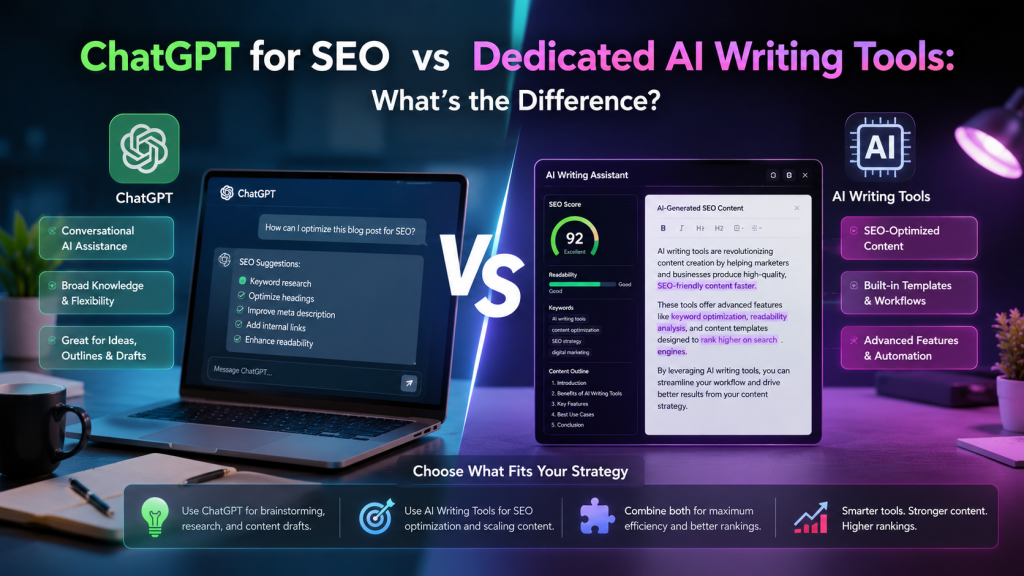
ChatGPT is genuinely impressive. It can write a 1,000-word blog post in seconds, answer complex questions, and mimic almost any writing style you throw at it. So when marketers and content teams started asking “can we just use ChatGPT for SEO?” the answer seemed obvious: yes, probably. But the more you use it for structured, consistent, brand-aware SEO publishing, the more the cracks appear. ChatGPT is a general-purpose language model. Dedicated AI writing tools are built specifically for content production at scale, with SEO and GEO baked into every step. The difference is not subtle.
Key Takeaways:
- ChatGPT generates text well but has no native SEO layer: no keyword targeting, no internal link logic, no brand memory
- Dedicated AI writing tools wrap structured workflows around AI generation: outlines, brand profiles, format templates, and link management
- GEO (Generative Engine Optimization) is a capability gap ChatGPT cannot bridge alone
- For one-off tasks, ChatGPT is fine; for consistent SEO publishing at scale, a purpose-built tool is meaningfully faster and more reliable
- AI Visibility tracking (knowing whether your brand appears in AI-generated answers) requires infrastructure that goes far beyond a chat interface
ChatGPT Can Write SEO Content, But Is It Built for That?
ChatGPT can produce a blog post that looks SEO-ready. Good length, readable headings, a reasonable structure. The problem is that “looks SEO-ready” and “is SEO-optimized” are not the same thing. ChatGPT has no access to your target keywords unless you paste them in. It has no knowledge of your existing content, your internal link profile, or what topics you have already covered. It does not know your brand voice unless you explain it every single time. And it has no opinion on whether the article you just generated serves informational intent, commercial intent, or something in between.
That is not a criticism of ChatGPT. It is just not what the tool was designed for. It is a conversational AI assistant built to respond to prompts, not a content production system built to serve SEO workflows. The distinction matters more than most teams realize until they have spent a few weeks trying to publish consistent, on-brand SEO content using a chat interface.
How General-Purpose AI Models Approach Content Writing
When you ask ChatGPT to write an article, it generates text based on your prompt. The quality of that text depends almost entirely on how well you write the prompt. If you know exactly what you want, can specify the tone, the target keyword, the structure, the word count, the internal links, the FAQ format, and the brand voice constraints, you can get decent output. That is a lot of work to do manually every time.
There is also no continuity. ChatGPT does not remember the article you wrote last week, the cluster strategy you are executing, or the competitor gaps you are targeting. Every session starts from zero. For a one-off task, that is fine. For a team publishing 20 articles a month across three brands, it creates a real consistency problem.
Most SEO practitioners who have used ChatGPT heavily for content agree: the tool is fastest for brainstorming and drafting when you already know exactly what you want. It struggles when the task requires structural judgment, brand context, or SEO-specific decision-making built into the process.
What Dedicated AI Writing Tools Do Differently
Purpose-built AI writing tools do not just generate text faster. They change the structure of the process entirely. Instead of a blank chat window, you get a workflow: enter your title and target keywords, generate a structured outline, review it, then write the full article with all your brand context pre-loaded.
With a tool like ContentSuper, the brand voice, tone settings, and keyword preferences are stored in a Brand Profile. You can read more about how these workflows fit together in our AI Content guide. Internal links are managed in a separate module and get matched to relevant articles automatically. Format templates handle the structural decisions you would otherwise make manually: is this a how-to guide, a comparison piece, a listicle, or a pillar page? Each format produces a different content structure optimized for how that content type performs in search.
The result is that the cognitive load of producing SEO content shifts away from the writer and onto the system. You make editorial decisions; the platform handles the SEO scaffolding. That is a fundamentally different relationship with AI-assisted writing than ChatGPT offers.
The SEO Gap: Keyword Targeting, Internal Links, and Content Structure
One of the most practical gaps between ChatGPT and dedicated tools is internal linking. Internal links matter for SEO because they signal topical relationships to search engines and pass authority between pages. Managing them manually across a large content library is tedious and error-prone. Purpose-built writing platforms handle this at the system level: you define your internal link targets, and the AI places them contextually as it writes.
Keyword targeting is the other big structural gap. With ChatGPT, you paste in keywords and hope the model distributes them naturally. Purpose-built tools give you a structured approach to this, as covered in our AI Content writing guide. Dedicated tools let you specify primary and secondary keywords before generation begins, and the AI is instructed to use them correctly: in the first paragraph, in at least two headings, and naturally throughout the body.
Content structure for topical authority is harder to maintain through a chat interface. Topic cluster strategy, where a pillar page covers a broad topic and satellite articles cover subtopics in depth all linked together, requires consistency across dozens of articles. Dedicated tools often include cluster planning features that map this structure and track which gaps still need to be filled.
GEO: Where Dedicated Tools Extend Well Beyond ChatGPT
GEO (Generative Engine Optimization) is the practice of structuring content so it is more likely to be cited, quoted, or recommended by AI systems such as ChatGPT, Gemini, Perplexity, and Claude when users ask questions in those tools. While traditional SEO targets search engine ranking algorithms, GEO targets the retrieval and citation behavior of large language models.
Most users who rely on ChatGPT for content have not thought about GEO at all, which makes sense: ChatGPT is not a GEO tool. It does not apply direct-answer formatting, does not optimize for entity richness or AI citability, and does not track whether your brand is appearing in AI-generated answers. It just writes.
Dedicated AI writing platforms built for GEO approach content differently. Articles are structured so that introductions function as standalone summaries that AI systems can cite directly. FAQ sections are written in direct-answer format, which is exactly how AI systems surface information in response to user queries. Named entities (specific tools, platforms, standards, and techniques) are woven in deliberately to increase the chance that an AI model treats the page as a reliable source.
There is also the question of measurement. Tools like the AI visibility tool from ContentSuper track whether your brand is being mentioned in AI-generated answers across ChatGPT, Gemini, and Claude. That kind of visibility tracking does not exist inside ChatGPT. You cannot ask ChatGPT to tell you how visible your brand is in AI search. You need a dedicated system for that.
When ChatGPT Is Enough, and When It Is Not
ChatGPT is genuinely useful for a specific range of content tasks: quick drafts you plan to rewrite heavily, brainstorming headline angles, rephrasing an awkward paragraph, or generating a first-pass outline you will restructure manually. For those jobs, it is fast and good enough.
The problems start when you try to run a content program through it. Publishing consistency, brand voice compliance across writers and articles, cluster strategy, internal link management, GEO formatting: none of these are things ChatGPT handles well without significant manual effort on your part. The more of that effort you add, the less you are actually saving.
A practical way to think about it: if you are publishing fewer than four articles a month, have one brand, and are comfortable writing detailed prompts every time, ChatGPT might work. If you are running a content program with real publishing targets, multiple brands or clients, and any interest in GEO, a dedicated tool will save you time and produce better output with less effort.
| Factor | ChatGPT | Dedicated AI Writing Tool |
|---|---|---|
| Brand voice memory | Manual (prompt each time) | Stored in Brand Profile |
| SEO keyword targeting | Manual (paste in prompt) | Built into generation workflow |
| Internal link management | Manual | Automated with matching |
| Content format templates | None | 9+ structured formats |
| GEO optimization | Not built in | Native to content structure |
| AI Visibility tracking | Not available | Dedicated feature |
| Topic cluster planning | Not available | Built-in planner |
| Multi-brand support | Session-based only | Separate workspaces per brand |
According to data from the Content Marketing Institute’s 2024 B2B Content Marketing report, teams using purpose-built content tools report significantly higher publishing consistency than those using general-purpose AI tools without structured workflows.
FAQ
Can ChatGPT replace dedicated AI writing tools for SEO?
For most SEO publishing workflows, no. ChatGPT can generate text, but it does not manage keyword targeting, internal linking, brand voice, or content structure in a repeatable way. Every session starts fresh with no memory of your brand, past articles, or cluster strategy. Dedicated tools wrap all of that context around the generation step, which is why they produce more consistent output with less manual effort per article.
What does a dedicated AI writing tool offer that ChatGPT does not?
The main differences are workflow structure and context persistence. Dedicated tools store your brand profile, manage internal links automatically, provide format templates for different article types, and let you build topic clusters with visibility into which content gaps remain. They also apply GEO optimization principles natively, which ChatGPT does not. For teams publishing regularly, these are not small conveniences, they are what make consistent content production possible.
What is GEO and why does it matter for content strategy?
GEO stands for Generative Engine Optimization. It refers to structuring content so that AI systems like ChatGPT, Gemini, and Perplexity are more likely to cite or recommend it in their answers. As more users shift from Google searches to AI-generated answers, appearing in those AI responses becomes a new form of brand visibility. You can learn more in our GEO optimize tool guide.
Is ContentSuper better than ChatGPT for content writing?
They are different tools for different jobs. ChatGPT is a general-purpose assistant. ContentSuper is a structured content production platform with SEO and GEO workflows built in. If your goal is to publish SEO-optimized, brand-consistent content at scale and track your visibility in AI-generated search results, ContentSuper is the more capable tool for that specific job.
The Right Tool for Serious SEO Content
ChatGPT is not a bad tool. It is the wrong tool when the job requires structured, consistent, brand-aware SEO publishing with GEO built in. The gap between a general-purpose chat interface and a purpose-built content platform is the difference between a text generator and a content system.
If you are serious about SEO content, publishing consistently, building topical authority, managing internal links, and showing up in AI-generated answers, you need infrastructure, not just a chat window. ContentSuper is built for exactly that. It handles the SEO scaffolding, applies GEO best practices to every article, and gives you the AI visibility tool you need to track how your brand performs across AI platforms.
Start with a free trial and see how much faster structured AI writing can be when the tool is actually built for the job. Visit the SEO/GEO writing tool to get started.