
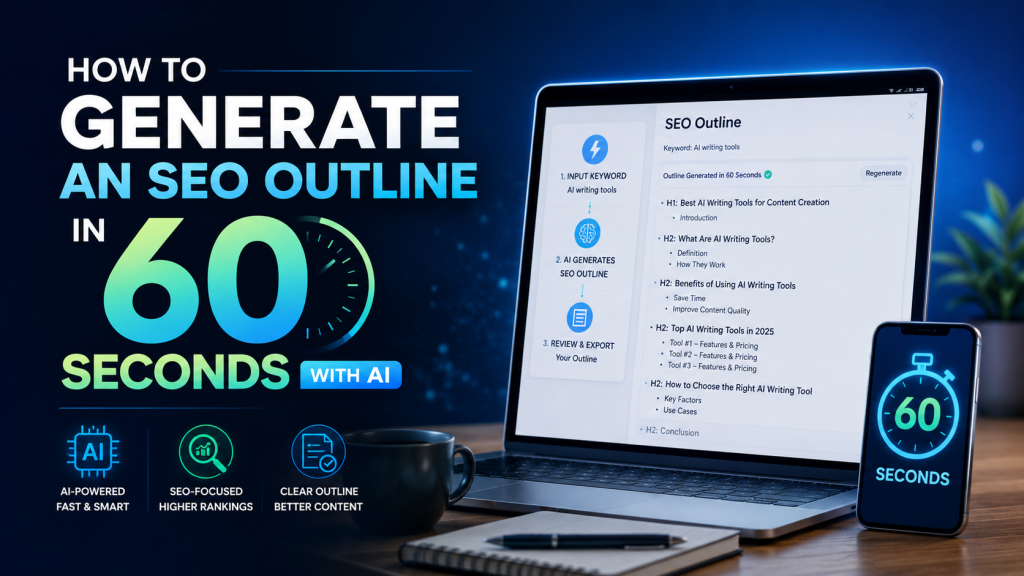
Most articles fail before a single word is written. The structure is wrong, the H2s don’t match search intent, and the logical flow that Google rewards is missing entirely. Manually building a solid SEO outline used to take 30 to 60 minutes of keyword research, SERP analysis, and iteration. With AI, that same outline takes under 60 seconds. This guide covers exactly how to generate a winning SEO outline using AI, what separates a good outline from a great one, and why structure is the single most important decision you make before writing.
Key Takeaways:
- A well-structured outline determines whether your article ranks, not just the content inside it
- AI generates a complete, intent-matched SEO outline in under 60 seconds using your title and target keywords
- ContentSuper offers 9 distinct article formats, each producing a different outline structure matched to a specific search intent
- An outline built for SEO in 2025 also needs to be structured for AI citation, not just Google ranking
- You can edit, reorder, and customize your AI-generated outline before committing to the full article
Why Your SEO Outline Determines Whether Your Article Ranks
The outline is not a planning document. It is the architecture of your ranking signal. Every H2 heading is a topical coverage decision. Every section order is a relevance signal. When Google crawls a page, the heading hierarchy tells it what the page is about, how thoroughly it covers the topic, and whether it aligns with the query that brought a user there.
Most writers treat the outline as a rough sketch and expect the writing to fix problems. It does not. If your H2s do not map to the sub-questions users are actually searching, no amount of good prose recovers the ranking potential. Search intent has to be baked in at the structural level.
The practical difference between manual and AI outlining is not just speed. A human building an outline from scratch has to mentally hold keyword data, competitor structure, and content logic simultaneously. AI does all three in seconds, without the cognitive load. What used to require a content strategist now takes a writer 60 seconds and a click.
What Makes a Winning SEO Outline in 2025
A strong SEO outline in 2025 has a few non-negotiable elements. The primary keyword appears in the H1, naturally and early. Each H2 heading is intent-matched, meaning it addresses a specific sub-question a user searching that topic would actually ask. There is a FAQ block for long-tail and conversational queries. And there is a closing section that either converts or points the reader somewhere useful.
Beyond those basics, Google rewards topical completeness. An outline that covers only the surface of a topic signals a thin article. An outline that maps the full topic, covers adjacent angles, and addresses the “also asked” queries signals authority. That topical completeness is what earns featured snippets and AI Overviews inclusions.
What is topical completeness? Topical completeness refers to how thoroughly a single piece of content covers all meaningful sub-topics, related questions, and contextual angles of a given subject. Search engines and AI systems use topical completeness as a proxy for authority. A page that covers a topic end-to-end is more likely to be cited, ranked, and surfaced in AI-generated answers than one that covers only the most obvious angle.
AI systems in 2025 read heading structure differently from human readers. A heading like “Step 1: Enter your title and keywords” is not just a UX label. It is an entity signal that tells an LLM this article explains a procedural process. Getting your heading semantics right matters for both traditional SEO and generative engine optimization (GEO).
How ContentSuper Generates an SEO Outline in Under 60 Seconds
The outline generation workflow in ContentSuper is deliberately minimal. You provide a title and your target SEO keywords, separated by commas. The platform handles the rest.
Here is the exact sequence. From the sidebar, go to Articles and click + New Article. Select your Brand Profile, which gives the AI context about your tone, audience, and domain. Enter your article title and SEO keywords. If you want more control, open Advanced Options to set article format, output language, search intent, or word count. Then click Generate Outline.
Within two to three seconds, the AI returns a structured H2 outline. This is not a generic template. The outline is shaped by your specific title, your keywords, the article format you selected, and any custom instructions stored in your brand profile. Before committing to the full article, you can edit directly: add a heading, delete one that does not fit, or reorder sections. The outline is a starting point you control, not a locked output.
This is where the time saving actually lives. A content strategist building the same outline manually would start with a SERP analysis, check “People Also Ask” results, scan competitor H2 structures, then draft and revise. The AI compresses all of that into one step. According to a 2024 Nielsen Norman Group study on AI-assisted content workflows, writers using AI for structural planning reported a 70% reduction in pre-writing time while maintaining or improving content quality scores.
The 9 Article Formats and When to Use Each
ContentSuper does not generate one generic outline regardless of topic. It uses nine distinct article formats, and each one produces a structurally different outline. Choosing the right format is what separates a good AI outline from a great one.
| Format | Best For | Key Structural Feature |
|---|---|---|
| SEO Article | General informational queries | Direct-answer intro, FAQ at end |
| Pillar Page Hub | Broad, cluster-central topics | 8-10 H2s, long FAQ, internal link targets |
| How-to Guide | Procedural queries (“how to…”) | Step-numbered headings, sequential flow |
| Listicle (Top N) | Ranked recommendations | Numbered items (#1, #2), How to Choose section |
| In-depth Guide | Expert-level, research-heavy topics | 250-400 words per section, dense coverage |
| FAQ Article | High question-volume topics | Most H2s are questions, each answer stands alone |
| News / Update | Timely announcements, releases | Inverted pyramid, most important info first |
| Product Review | Single product analysis | Overview, features, pros/cons, verdict with rating |
| Comparison / vs | Two or more options side by side | Mandatory comparison table, balanced coverage |
When you select a format before generating, the AI adapts the outline structure accordingly. A “How-to Guide” outline produces step-numbered headings. A “Comparison / vs” format ensures a markdown table appears in the structure. The format is not cosmetic; it fundamentally changes the H2 logic and what SERP features the resulting article can target.
For most informational blog posts, the SEO Article or In-depth Guide format works. For content targeting commercial queries where users are evaluating options, the Comparison or Product Review format aligns better with what the SERP rewards.
From Outline to Published Article: The Full Workflow
Once your outline is approved, the next step is one click: Write Full Article. ContentSuper streams the article in real time, showing progress as a percentage so you know exactly where the generation stands. When it completes, the platform automatically generates a meta description and suggested tags alongside the article preview.
From there, you save it to your articles database, assign a status (Draft, Ready, or Published), and add the Published URL once the article is live. The built-in WYSIWYG editor handles any final adjustments without leaving the platform, with an optional Markdown mode for direct editing.
For teams producing content at scale, the Topic Cluster Planner changes the equation further. You define a pillar topic, set the number of articles in your cluster (5, 8, 10, or 15), and ContentSuper generates the full cluster plan with a recommended publication order. Each gap article can be bulk-generated, with outlines and full drafts produced sequentially and auto-saved. This is where the AI Content writing guide approach to content architecture becomes operational, not theoretical. If you are new to the platform, the AI Content guide covers how all the pieces fit together.
For agencies and content-heavy brands, the Bulk Generate feature means a cluster of 10 articles can move from outline to draft in a single session, with no manual intervention between steps.
GEO-Proofing Your Outline for AI Search Engines
Ranking on Google and being cited by AI systems require overlapping but not identical structural choices. As an SEO/GEO writing tool, ContentSuper is built to satisfy both, and the outline is where GEO optimization begins.
AI systems like ChatGPT, Gemini, and Perplexity use Retrieval-Augmented Generation (RAG) to pull from indexed content when composing answers. The articles they cite share a clear pattern: topical scope established in the introduction, direct-answer paragraphs that open with the answer rather than build toward it, and named entities (tools, platforms, techniques, standards) that the model can recognize as authority signals. Tracking whether your content is being cited across these platforms is where an AI visibility tool adds measurable value alongside your content workflow.
What does this mean for your outline? Each H2 heading should be specific enough that the section beneath it can open with a one-sentence direct answer. “What Makes a Winning SEO Outline” is better than “SEO Outline Tips” because it implies a direct-answer structure. A heading like “Benefits of Using AI for Content” is too vague to prompt a citable paragraph. The more precise the heading, the more citable the content it frames.
Entity density matters too. An outline that references E-E-A-T, schema markup, AI Overviews, or named platforms gives the AI-generated article a richer semantic footprint. These are the signals that lift content from “indexed” to “cited” in generative engine outputs. The emerging consensus in GEO is that entity-rich heading structure is one of the most reliable ways to increase share of voice in AI-generated answers. For the full optimization framework, the GEO optimize tool covers this in depth.
FAQ: AI SEO Outline Generator
Can AI really generate a complete, usable SEO outline without editing?
Yes, in most cases the AI-generated outline is usable as-is, though editing is still worthwhile. ContentSuper generates outlines based on your title, keywords, article format, and brand profile, meaning the output is context-aware rather than generic. In practice, most writers make one or two adjustments: adding a section that reflects a specific angle or removing a heading that does not fit the scope. Treat it as a strong first draft, not a finished spec.
How is an AI-generated outline different from a template?
A template is a fixed structure you fill in. An AI-generated outline is adaptive. It responds to the specific title, the keywords you provide, and the format you select. Two articles with different titles but the same format will produce different H2 structures because the AI considers search intent, logical flow, and topical completeness simultaneously rather than applying a fixed pattern. This is why AI outlining consistently outperforms keyword-stuffed template libraries.
Does the outline format affect how Google and AI engines rank the article?
Yes. The outline format determines the heading hierarchy, which is a core ranking signal for both traditional search and generative AI. A well-structured outline produces an article with clear topical scope, logical section progression, and direct-answer paragraphs. Google rewards this with featured snippets and high organic CTR. AI systems reward it with citation in generated answers. Format choice also affects whether the article triggers SERP features like “How-to” rich results or FAQ schema eligibility.
How many H2s should an SEO article outline have?
Most SEO practitioners agree that 5 to 8 H2s is the practical range for a 1,500 to 2,500-word article. Fewer than 5 risks topical incompleteness. More than 8 can fragment content into sections too short to carry authority. ContentSuper defaults to 8 sections per outline, which includes the introduction, 5 to 6 body sections, a FAQ block, and a CTA. This structure consistently performs well in both traditional SERPs and AI-generated answer sets.
What is the difference between SEO and GEO optimization for outlines?
SEO optimization focuses on keyword placement, heading hierarchy, and SERP feature triggers like FAQs and how-to steps. GEO optimization focuses on entity density, direct-answer paragraph structure, and topical completeness for AI citability. A GEO-optimized outline ensures each heading implies a direct-answer section and includes named entities that AI models recognize as authority signals. The best outlines satisfy both requirements simultaneously, which is the structural goal ContentSuper is built around.
Generate Your First SEO Outline in 60 Seconds
Sixty seconds is not a metaphor. Enter a title, add your keywords, pick a format, click Generate Outline. That is the full process. What you get back is a structured, intent-matched, editable outline ready to become a full article.
ContentSuper’s Free Trial gives you 7 days to test the complete workflow, no credit card required. You get 3 articles, access to all 9 article formats, and the full outline-to-draft pipeline. The Starter plan at $12/month scales to 10 articles per month. The Pro plan at $26/month covers 3 brand profiles and 30 articles per month, which is where most serious content teams operate.
The outline is where ranking starts. Stop spending an hour on manual structure and start generating outlines built for both search engines and AI from the first click.