
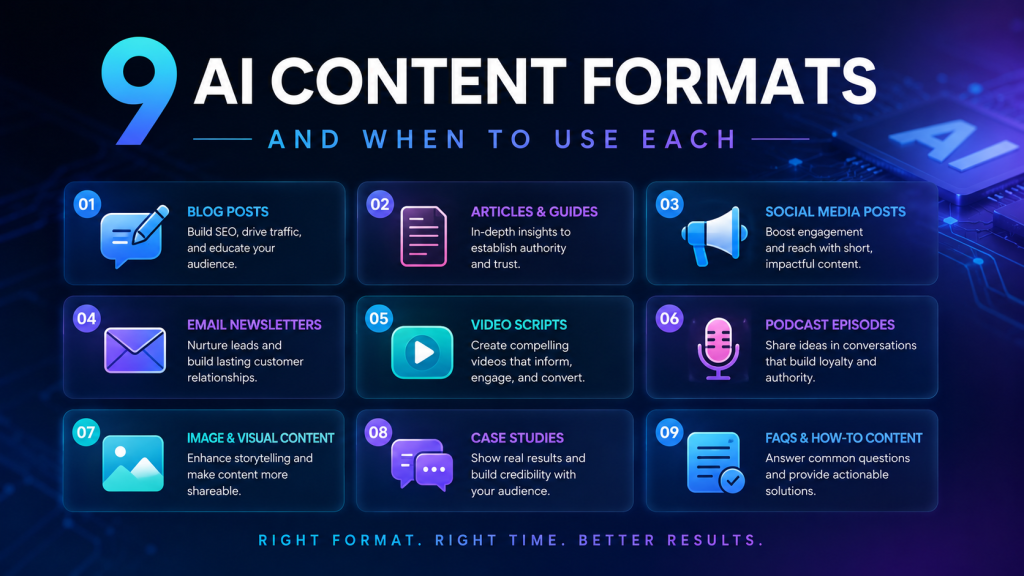
Most content strategy conversations fixate on keywords, word count, and publishing frequency. Format barely gets a mention. That’s a mistake. The format you choose determines how your content is structured, how readers navigate it, and critically, whether AI systems like ChatGPT, Gemini, or Google’s AI Overviews can parse it well enough to cite it. Pick the wrong format for a query and you’ll struggle to rank, regardless of how good the writing is.
ContentSuper supports nine distinct article formats, each built around a different information architecture and reader intent. This guide walks through all nine: what they are, when they work, and when to skip them.
Key Takeaways:
- Content format is a structural decision that affects both SEO rankings and GEO citation rates
- Each of ContentSuper’s 9 formats is optimized for a specific query type and search intent
- Comparison tables, FAQ-heavy formats, and step-labeled how-to guides are the most frequently cited formats in AI-generated answers
- Matching format to intent is as important as matching keywords to topic
- ContentSuper’s article creation workflow lets you select format before outline generation, so the AI structures the piece correctly from the start
What Are AI Content Formats and Why They Matter Now
AI content formats are pre-set structural templates that define how a piece of content is organized: which heading types appear, how sections are sequenced, whether the article uses tables or numbered steps, and how the introduction is framed.
Format vs. Template: A content format is not a rigid template. It is an information architecture decision. It tells both readers and AI systems what kind of content to expect, how to navigate it, and which sections are most likely to answer their specific question.
This distinction matters more than it used to. In traditional SEO, format influenced user experience and time-on-page. In the current landscape, format directly affects whether your content gets surfaced in AI Overviews, cited by Perplexity, or referenced in a ChatGPT response. LLMs parse structure. A direct-answer intro, a comparison table, or a self-contained FAQ block is far easier for an AI to extract and cite than a wall of prose. Format is now part of your GEO optimize tool strategy, not just your UX strategy.
SEO Article: Your Workhorse Format
The SEO Article is the default format for a reason. It handles the widest range of queries and is the safest choice when you are not sure which format fits best.
Structure: Direct-answer introduction, 4-6 supporting H2 sections covering the topic from multiple angles, and a FAQ section at the end. The intro is designed to function as a standalone summary, which makes it especially strong for featured snippet targeting and AI citation.
Best for: Broad informational queries (“what is content marketing”), evergreen brand keyword pages, and topics where readers want a comprehensive overview rather than a specific how-to or comparison.
When to skip it: If the query contains step-by-step intent (“how to set up”), a numbered list (“best tools for”), or a direct comparison (“X vs Y”), a more specific format will outperform the generic SEO Article. The format works well across most AI Content writing guide scenarios, but it is not the right call when search intent is highly specific.
Pillar Page Hub, How-to Guide, and In-depth Guide: Building Topical Authority
These three formats share a common goal: establishing a brand as the authoritative source on a topic cluster, not just a single query.
Pillar Page Hub is the anchor of a content cluster. It covers a broad topic comprehensively with 8-10 H2 sections, a long FAQ, and internal links pointing out to satellite pages. The Pillar format signals topical authority to both Google and LLMs. When Perplexity or ChatGPT assembles an answer about a topic, a well-structured pillar page is exactly the kind of comprehensive source they draw from.
How-to Guide uses step-labeled headings (“Step 1: …”, “Step 2: …”) to walk readers through a process. This format triggers how-to rich results in Google and maps cleanly to procedural queries. Each step is self-contained enough that an AI system can extract individual steps without losing context.
In-depth Guide is the format for complex topics that require 250-400 words per section to cover properly. Think of it as a long-form Pillar with more prose density per section and fewer internal links. It works best when your topic demands genuine depth and your audience has the patience to read it.
All three formats support E-E-A-T signals by demonstrating breadth of knowledge on a subject. According to Google’s Search Quality Evaluator Guidelines, content that demonstrates first-hand expertise and covers a topic thoroughly scores higher on experience and authority dimensions.
Listicle, FAQ Article, and Comparison/vs: High-Click Formats
These three formats dominate click-through rates in search results and citation rates in AI answers. They are also the formats most likely to be misused.
Listicle uses numbered items with the format “#1 – …”, “#2 – …” and typically closes with a “How to Choose” section. Listicles trigger list-type featured snippets and perform well for “best of” and “top N” queries. The key is that each item needs to be substantive enough to stand alone. A listicle with six weak items outperforms one with twelve shallow ones.
FAQ Article is structured so that most H2 headings are questions and each Q&A block can be read independently. This format is exceptionally well-suited for AI Overviews, because the AI can lift individual Q&A pairs without needing surrounding context. If your topic is one that users research by asking questions, the FAQ Article format is worth serious consideration.
Comparison/vs requires a markdown table comparing two or more options across defined criteria. This is non-negotiable in ContentSuper’s implementation of the format, and for good reason: comparison tables are reliably parsed by LLMs and frequently surfaced in AI-generated answers to comparison queries. When someone asks ChatGPT “which content platform should I use,” a well-structured comparison table from a published article is exactly the format that gets cited.
Use Comparison/vs when the query contains “vs,” “versus,” “alternative to,” or “which is better.” Do not use it as a general-purpose format. A comparison article with nothing concrete to compare feels thin and ranks accordingly.
News/Update and Product Review: Specialized Formats with Clear Triggers
These two formats have narrow use cases. Used correctly, they are highly effective. Used indiscriminately, they dilute your content strategy.
News/Update uses an inverted pyramid structure: the most important information comes first, followed by supporting detail. This format is designed for time-sensitive content: product launches, platform updates, industry announcements, or breaking research. The upside is that fresh, structured news content can generate topical authority spikes and attract backlinks quickly. The downside is that it ages poorly. A News article that was relevant in Q1 becomes a liability by Q3 unless it is updated.
Product Review follows a predictable arc: product overview, key features, pros and cons, and a verdict with a rating. This format triggers product review rich results in Google (when marked up with appropriate schema) and gives readers a decision-making framework. It works well for commercial queries where the reader is close to a purchase decision.
Where brands go wrong with these formats: using News structure for evergreen topics, or writing Product Reviews without genuine hands-on evaluation. Both Google’s quality guidelines and LLM citation patterns favor content that demonstrates real experience with the subject. A hollow review gets neither rankings nor citations.
How to Match Format to Search Intent
Choosing the right format is a two-step process: read the query intent, then match it to the format that serves that intent best.
| Query signal | Recommended format |
|---|---|
| “What is…” / “Why is…” | SEO Article |
| “How to…” / “Step-by-step…” | How-to Guide |
| “Best…” / “Top N…” | Listicle |
| “X vs Y” / “Alternative to…” | Comparison/vs |
| “Everything about…” / “[Topic] guide” | Pillar Page Hub or In-depth Guide |
| Questions about a specific topic | FAQ Article |
| “[Product] update” / “New feature” | News/Update |
| “[Product] review” / “Is X worth it?” | Product Review |
From a GEO perspective, the formats that get cited most often by ChatGPT, Gemini, and Perplexity are: Comparison/vs (tables are easy to extract), FAQ Article (self-contained Q&A pairs), and How-to Guide (numbered steps transfer cleanly to AI answers). If your goal is to increase brand presence in AI-generated responses, weight your content calendar toward these three.
ContentSuper’s article creation workflow includes a format selector before the outline generation step. Choosing your format first means the AI structures the entire piece, from heading hierarchy to FAQ placement, according to the format’s conventions. This is meaningfully different from generating a generic article and trying to retrofit a structure afterward.
If you want a comprehensive view of how format selection fits into a full content strategy, the AI Content guide covers content planning, cluster architecture, and format decisions in one place.
Frequently Asked Questions
Can I use multiple formats in one article?
Technically yes, but it usually creates structural confusion. Each format has an implicit contract with the reader: a listicle promises a ranked list, a how-to promises sequential steps. Mixing formats mid-article breaks that contract. A better approach is to choose the primary format that fits the main intent, then borrow specific elements (like a comparison table or a FAQ block at the end) without abandoning the core structure.
Which AI content format is best for ranking in AI Overviews?
FAQ Article and Comparison/vs formats consistently perform well in AI Overviews. FAQ content maps directly to how AI systems assemble question-answer responses. Comparison tables give AI systems structured, extractable data. SEO Articles with strong direct-answer introductions also perform well, since the intro paragraph is often the section AI Overviews pull from. The common thread is structured, self-contained information that does not require surrounding context to make sense.
How do content formats affect GEO and AI visibility?
Format affects how easily an AI can parse, extract, and cite your content. Markdown tables, numbered steps, blockquote definitions, and self-contained Q&A blocks are all structurally easy for LLMs to process. Unbroken walls of prose are harder. Well-structured content in the right format is more likely to appear in AI-generated answers, which directly affects brand AI visibility tool metrics like mention rate and share of voice in AI responses.
Does ContentSuper auto-select the right format?
ContentSuper does not auto-select, because format is a strategic decision that depends on factors beyond the title alone: your competitive positioning, your cluster strategy, your target intent. Instead, the platform gives you nine clearly defined formats with descriptions so you can make an informed choice. Once you select a format, the AI applies that format’s conventions to both the outline and the full article generation.
What happens if I pick the wrong format?
Picking the wrong format is recoverable. If you generate an outline and realize the format does not fit the topic, you can switch formats and regenerate the outline before writing the full article. ContentSuper’s workflow gates full article generation behind outline approval specifically so you can catch structural issues early.
Start Writing in the Right Format Today
Format is not a cosmetic decision. It shapes how your content is read, ranked, and cited. Most teams default to the same structure for every article and wonder why some pieces perform dramatically better than others. Often, the answer is format.
ContentSuper’s SEO/GEO writing tool gives you nine format options, each tuned for a specific query type and intent. Select your format, generate a structured outline, and write a full article optimized for both search engines and AI systems. No retrofitting, no guessing.