
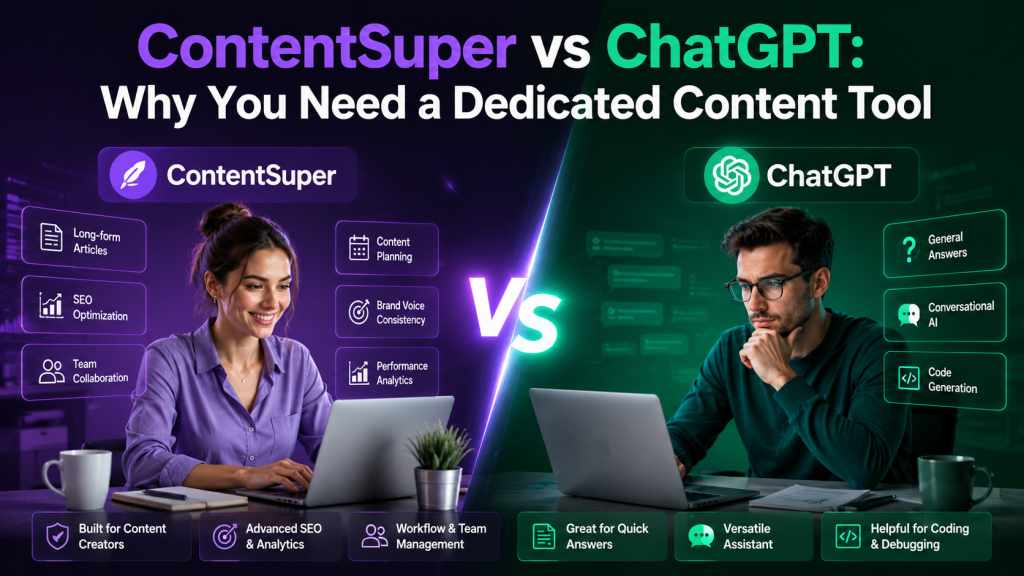
ChatGPT and ContentSuper solve different problems. ChatGPT is a general-purpose assistant you prompt from scratch every time. ContentSuper is a dedicated SEO/GEO writing tool built specifically for teams publishing SEO and GEO-optimized content at scale, with brand memory, structured workflows, and a way to measure whether your brand actually shows up in AI answers. If you’re writing one blog post a month, ChatGPT alone might be enough. If you’re running a content program, the gap becomes obvious fast: no persistent brand voice, no SEO scoring, no internal linking logic, and no visibility into whether any of it is working once it’s published.
Key Takeaways:
- ChatGPT is a general assistant with no memory of your brand voice, keywords, or past content between sessions
- ContentSuper stores a Brand Profile once and applies it automatically to every article, outline, and cluster
- Only a dedicated platform like ContentSuper’s AI Visibility Checker tells you whether your brand is being cited in ChatGPT, Gemini, Claude, and Perplexity answers
- SEO and GEO are not the same discipline, and ChatGPT alone doesn’t optimize for either one systematically
- Dedicated tools pay off once you’re publishing regularly or managing more than one brand
Why People Default to ChatGPT for Content First
It makes sense. ChatGPT is fast, familiar, and free to start. You open a tab, type a prompt, and get a draft in seconds. For brainstorming headlines, punching up a paragraph, or writing a one-off social caption, that’s genuinely useful, and most SEO practitioners agree there’s no reason to avoid it for quick, low-stakes writing tasks.
The friction shows up at scale. Every new session starts from zero. You re-explain your brand’s tone, re-paste your keyword list, and re-describe your audience, article after article. There’s no record of what you’ve already published, so overlapping topics and repeated internal links become a manual tracking problem. For a single post, that’s a minor annoyance. For a content calendar with 10 or 20 articles a month, it turns into real overhead that eats the time savings ChatGPT was supposed to provide.
What ChatGPT Doesn’t Do Out of the Box
ChatGPT has no concept of a Brand Profile. It won’t remember your tone of voice, your target audience, or your “keywords to avoid” list from one conversation to the next unless you paste them in every time, and even then, consistency across a growing archive of content is hard to enforce manually.
It also isn’t built for SEO or GEO scoring. There’s no structured check for keyword placement, no automatic internal linking based on topical relevance, and no content cluster planning that maps a pillar page against its supporting satellite articles. You can ask ChatGPT to “write SEO content,” but you’re relying on the prompt alone to enforce structure, and nothing verifies the output against actual ranking or citation signals afterward.
The bigger gap is visibility. You can use ChatGPT to write content all day, but ChatGPT won’t tell you if your brand is the one showing up when someone else asks it a related question. That distinction, using the tool to write versus appearing in the tool’s answers, is the one most teams miss.
ContentSuper vs ChatGPT: Side-by-Side Comparison
Here’s how the two compare on the capabilities that matter for an ongoing content operation, not a single draft:
| Capability | ChatGPT | ContentSuper |
|---|---|---|
| Brand voice memory across sessions | No, re-prompt each time | Yes, saved in Brand Profile |
| SEO keyword structuring | Manual, prompt-dependent | Built into the outline and writing workflow |
| GEO optimization for AI citation | Not built-in | Core design principle (direct-answer format, entity density, structured claims) |
| Internal linking logic | Manual | Automatic, based on keyword matching to your link library |
| Topic cluster planning | Not available | Dedicated Topic Cluster Planner with pillar and satellite tracking |
| AI Visibility tracking (ChatGPT, Gemini, Claude, Perplexity) | Not available | Built-in AI visibility tool |
| Multi-brand workspace switching | Not available | Yes |
The pattern is consistent: ChatGPT is a strong drafting engine, and ContentSuper is a system built around that drafting step, with structure, memory, and measurement wrapped around it.
The Missing Piece: AI Visibility (Being Cited BY ChatGPT, Not Just Using It)
This is the part most comparisons skip. The emerging consensus in GEO is that the real competitive question isn’t “can I use ChatGPT to produce content faster,” it’s “does my brand get mentioned when someone else asks ChatGPT, Gemini, Claude, or Perplexity a question in my category.” Those are two completely different jobs, and ChatGPT only helps with the first one.
AI Visibility is the measurable degree to which a brand is mentioned, cited, or recommended inside AI-generated answers across platforms like ChatGPT, Gemini, Claude, and Perplexity, tracked the same way search engine rankings have traditionally been tracked for Google.
ContentSuper’s AI visibility tool runs real prompts, the kind actual users type into these assistants, against your target platforms on a schedule, then reports whether your brand showed up, how it compares to named competitors, and which sources the AI cited to back its answer. That last part matters most for content strategy: if you can see which URLs an AI model is pulling from, you know exactly what kind of content earns citations in your category, and you can build more of it.
When a Dedicated Tool Pays Off
A dedicated platform isn’t necessary for everyone. If you publish occasionally and don’t track SEO performance closely, ChatGPT alone will get the job done. The calculation changes under a few common conditions.
Teams publishing multiple articles a week feel the brand-consistency problem first: without stored guidelines, tone drifts between writers and sessions, and someone ends up manually auditing published posts for voice mismatches. Agencies and in-house teams managing several brands or clients run into a second problem, needing to switch context cleanly between brand voices, keyword sets, and internal link libraries without cross-contaminating them. And any team being asked to prove content ROI beyond raw output, whether their content actually gets cited by AI systems and not just how many words got published, needs visibility tracking that ChatGPT simply doesn’t offer.
According to Search Engine Journal’s ongoing coverage of AI Overviews and generative search, the share of search-adjacent queries answered directly inside AI interfaces has been climbing steadily, which means visibility inside those answers is becoming as important as traditional ranking position, not a replacement discipline sitting off to the side.
Frequently Asked Questions
Can I just use ChatGPT for SEO content?
You can, but you’ll be doing manually what a dedicated platform automates: keyword placement, internal linking, brand consistency, and format structure. ChatGPT can produce a solid draft, but it won’t score that draft against SEO best practices or track whether it performs, so you’re still responsible for the structure and the measurement layer yourself.
What does ContentSuper do that ChatGPT can’t?
ContentSuper stores your Brand Profile and internal link library so every article stays consistent automatically, structures content specifically for SEO and GEO (including direct-answer formatting and entity density), and includes an AI Visibility Checker that ChatGPT has no equivalent for: measuring whether your brand appears in AI-generated answers.
Does ContentSuper track if my brand appears in ChatGPT’s answers?
Yes. The AI Visibility feature sends real user-style prompts to ChatGPT, Gemini, Claude, and Perplexity, then reports whether your brand was mentioned, how visible you are compared to competitors, and which sources the AI cited in its response.
Is ContentSuper only for large teams?
No. Solo creators and small teams use it to keep brand voice consistent without re-explaining guidelines every session, while larger teams use the multi-brand workspace and topic cluster planning to manage content at higher volume.
Try ContentSuper for Your Next Article
If you’re already using ChatGPT for content and hitting the consistency, structure, or visibility gaps described above, ContentSuper is built to close them without adding a second tool to your workflow. Read the AI Content guide for a full walkthrough of how the platform works, or start with the AI Content writing guide if you want the SEO side explained first. When you’re ready to see where your brand currently stands in AI answers, the GEO optimize tool is the fastest way to find out, and it takes a few minutes to set up your first Brand Profile and run your first check.