
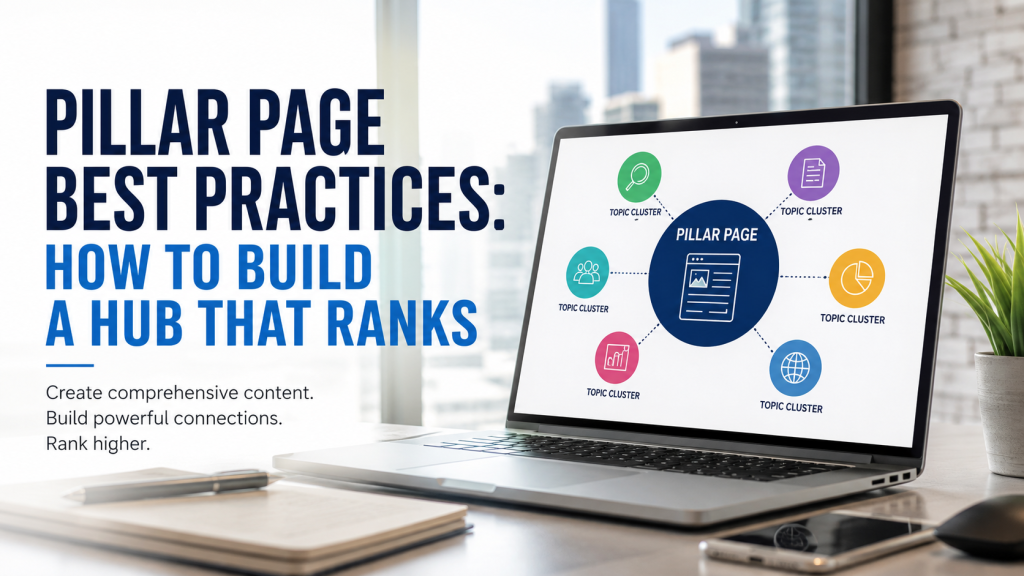
A pillar page is the backbone of a topic cluster strategy. It covers a broad subject comprehensively, links out to a network of supporting satellite pages, and signals to both search engines and AI systems that your brand owns a topic. Done right, a pillar page compounds in authority over time. Done wrong, it is just a long blog post that nobody finds.
Most pillar pages underperform not because the writing is bad, but because the architecture is wrong. They are built without a real cluster around them, stuffed with keywords instead of structured for intent, or published once and left to decay. This guide walks through pillar page best practices from structure to keyword strategy to internal linking, with a practical look at how AI-powered tools can accelerate the entire process.
Key Takeaways:
- A pillar page works only when surrounded by interconnected satellite pages that link back to it
- Topical completeness, not word count alone, determines whether Google and AI systems treat your page as authoritative
- Internal link architecture between pillar and satellites is as critical as the content itself
- AI tools can generate an entire cluster plan, identify content gaps, and bulk-produce satellite pages
- GEO-optimized pillar pages are structured to be cited by AI assistants, not just ranked by search engines
What a Pillar Page Actually Does (And Why Most Fail)
A pillar page is a long-form, comprehensive piece of content that covers a broad topic at a high level and links to a set of more specific satellite pages, each of which goes deeper on a subtopic. The pillar page sits at the center of a topic cluster. Satellite pages orbit around it, each covering one slice of the broader subject in detail.
That is the structure. The purpose is different. Pillar pages exist to establish topical authority, the signal that tells Google and AI systems your site is a reliable, complete source on a given subject. When your pillar page and its satellites collectively cover a topic from multiple angles, search engines treat your domain as an expert in that space. Individual pages rank better as a result.
So why do most pillar pages fail? Three reasons come up repeatedly. First, they are built without a real cluster: the pillar exists, but the satellite pages do not, so there is nothing to link to and no topical depth to signal. Second, they are structured like blog posts, optimized for one keyword rather than architected for navigational and informational intent across the whole topic. Third, they are published and forgotten. A pillar page needs satellite pages added over time and internal links updated as new content is created.
The Hub-and-Spoke Model: How Topic Clusters Work
The hub-and-spoke model is the most widely adopted content architecture in SEO today, and for good reason. The pillar page is the hub. Each satellite page is a spoke, covering a specific subtopic in depth and linking back to the hub. The hub links out to all the spokes. That bidirectional link flow is what gives the cluster its structural integrity.
From a search engine perspective, this architecture creates a clear map of your topical coverage. Google’s systems can see that your site addresses a broad subject from many angles, which aligns with E-E-A-T principles and topical authority signals. Most SEO practitioners agree that a well-linked cluster consistently outperforms a collection of standalone pages targeting similar keywords.
The GEO angle matters here too. LLMs like ChatGPT, Perplexity, and Gemini use Retrieval-Augmented Generation (RAG) to source answers. When a brand has interconnected, comprehensive content on a topic, AI systems are more likely to surface that brand in generated answers. A pillar page strategy is not just an SEO play; it is also a foundation for AI visibility. For a deeper look at how that works, the GEO optimize tool explains the mechanics of optimizing content for AI citation.
Anatomy of a High-Ranking Pillar Page
Structure matters more than length, though length matters too. According to Semrush’s 2024 State of Content Marketing report, the average top-ranking pillar page runs between 2,500 and 4,000 words, enough to achieve topical completeness without becoming unreadable.
For a broader look at how AI-powered content fits into this workflow, the AI Content guide covers the full platform picture. The essential structural elements of a well-built pillar page are:
Intent-matched title: The title should reflect broad informational or navigational intent. It is not trying to rank for one long-tail phrase; it is targeting a topic category.
Direct-answer introduction: The intro should function as a standalone summary. A reader (or an AI system) should understand what the page covers and why it matters from the first two paragraphs alone.
H2 structure that mirrors the cluster: Each major H2 section should correspond to a satellite topic in your cluster. This makes internal linking natural and keeps the architecture coherent.
Internal link anchors: Every H2 section that has a corresponding satellite page should link to it with descriptive anchor text. This is the connective tissue of the cluster.
FAQ section: Structured Q&A formatted for featured snippets and AI citation. Keep answers direct, 60-100 words each.
CTA: A clear next step that points deeper into your product or content ecosystem.
GEO explainer: A pillar page becomes AI-citable when it combines three things: entity-rich language (naming tools, platforms, and techniques explicitly), direct-answer formatting (the first sentence of each section answers the section’s implied question), and structured Q&A that an LLM can lift as a factual response without needing to paraphrase.
Keyword Strategy for Pillar Pages: Broad Intent, Deep Coverage
The keyword logic for a pillar page is the inverse of what you apply to a standard blog post. Instead of targeting a specific long-tail phrase with clear transactional or informational intent, a pillar page targets a broad head term with mixed intent, something a user might search when they want a comprehensive overview rather than a specific answer.
The long-tail, specific keywords belong to the satellite pages. Each satellite owns one slice of the topic and ranks for its own set of phrases. The pillar page benefits from the authority those satellites build and passes authority back down through internal links.
Keyword cannibalization is a real risk in cluster strategies. It happens when the pillar page and a satellite page compete for the same search intent, splitting traffic and confusing search engines about which page to rank. The fix is search intent mapping before you build: clearly define what question each page in the cluster is answering, and make sure no two pages are answering the same question.
Practical approach: use your pillar topic as the top of a content brief hierarchy. The pillar answers “what is X and why does it matter.” Each satellite answers a specific “how,” “which,” or “when” question within that topic.
Internal Linking: The Architecture That Makes Clusters Work
Content quality gets most of the attention in pillar page discussions. Internal linking gets most of the results. A pillar page with strong content but weak internal linking will consistently underperform one with average content and a tight link structure.
The core rule is bidirectionality. The pillar links out to every satellite. Every satellite links back to the pillar. This creates a closed loop of link equity that reinforces topical authority across the entire cluster. When Google crawls one page in the cluster, it finds paths to every other related page, which helps the whole cluster surface for relevant queries.
Anchor text matters. Use descriptive, varied anchor text that reflects the target page’s content, not generic phrases like “click here” or “read more.” At the same time, avoid over-optimization. If every internal link to your pillar uses the exact same anchor text, it reads as manipulative. Natural variation, using synonyms and related phrases, is both more readable and more algorithmically sound.
The most common internal linking mistake in pillar strategies: satellite pages that link to the pillar at launch but are never updated when new satellites are added. Every time a new spoke is added to the cluster, the pillar page and existing satellites should be updated to link to it.
How to Plan and Build a Pillar Page with AI Tools
Planning a topic cluster manually is time-consuming. You need to audit existing content, identify gaps, map search intent for each topic, and coordinate the publish order so satellites go live before the pillar links to them. AI-powered tools change the economics of that process significantly.
ContentSuper’s Topic Cluster Planner automates the most labor-intensive parts. You input a pillar topic, select how many articles you want in the cluster (5, 8, 10, or 15), and the platform generates a full cluster plan: satellite topics, suggested publish order, and gap detection based on what you have already written. Satellite pages are flagged with a recommended publish sequence so informational spokes go live first, and the pillar is published last with live pages to link to.
For teams producing content at scale, the Bulk Generate feature lets you queue multiple satellite pages and have them written sequentially, each one including a custom instruction to link back to the pillar. The result is a structurally coherent cluster built in a fraction of the time manual production would require.
The AI Content writing guide goes into detail on how AI generation fits into a broader SEO content workflow, including how to maintain quality and brand voice at volume.
If you want to understand how pillar pages and cluster content contribute to AI visibility (not just search rankings), the AI visibility tool tracks how often your brand and its content appear in AI-generated answers across ChatGPT, Gemini, Claude, and Perplexity.
FAQ: Pillar Page Best Practices
How long should a pillar page be?
Most high-performing pillar pages run between 2,500 and 4,000 words. The right length is determined by topical completeness, not an arbitrary word count target. Your pillar page should cover the topic broadly enough that a reader gets a solid understanding of the subject and clear paths to go deeper. If you hit 2,500 words and the topic feels fully addressed at a high level, that is the right length. Padding for the sake of length dilutes quality.
What is the difference between a pillar page and a blog post?
A blog post is typically optimized for one specific keyword and one specific search intent. A pillar page is built to anchor a topic cluster, covering a subject broadly and linking to multiple satellite pages that go deeper. Pillar pages tend to be longer, have a more deliberate H2 structure, and serve navigational and informational intent simultaneously. Blog posts live at the edges of the cluster; the pillar page is the center.
How many satellite pages should a topic cluster have?
A minimum viable cluster typically has 5 to 8 satellite pages. Larger topics with strong search volume can support 10 to 15 or more. The right number is driven by how many distinct subtopics exist within your pillar subject and how much search demand exists for each. Starting with 5 focused, well-written satellites is more effective than launching 15 thin pages.
How do I know if my pillar page is working?
Track three signals: organic traffic to the pillar page itself, rankings for your broad head keyword, and the rankings of satellite pages in the cluster. A working cluster shows improvement across all three over time, not just on the pillar. You should also monitor internal link click-through rates from satellite pages back to the pillar. If satellites are getting traffic but the pillar is not receiving internal clicks, your anchor text or link placement needs work.
Should a pillar page target GEO as well as SEO?
Yes, and the tactics overlap significantly. A pillar page that is well-structured for SEO (direct-answer intro, clear H2 sections, FAQ, entity-rich language) is also well-positioned for AI citation. The additional GEO-specific steps are: ensuring your intro functions as a standalone summary an AI could quote, using consensus-aligned language for key claims, and adding a definition or explainer block for the core concept. AI systems favor content that is both comprehensive and densely factual.
Build Your Content Hub Smarter
A high-ranking pillar page is an architecture decision before it is a writing decision. The cluster structure, keyword mapping, internal link design, and publish order all determine whether your content hub compounds in authority or sits static. Get the structure right, and the content does more work over a longer period of time.
ContentSuper’s Topic Cluster Planner handles the planning layer, the SEO/GEO writing tool. generates the content with both search and AI optimization built in, and the AI Visibility Checker tracks whether your cluster is showing up in AI-generated answers. You can start with a free trial, no credit card required, and have a full cluster plan ready in under ten minutes.
Content strategy built on solid architecture is not a short-term play. It is one that pays returns for as long as the cluster stays maintained and the content stays relevant. Start with the pillar, build the spokes, and keep connecting them.