
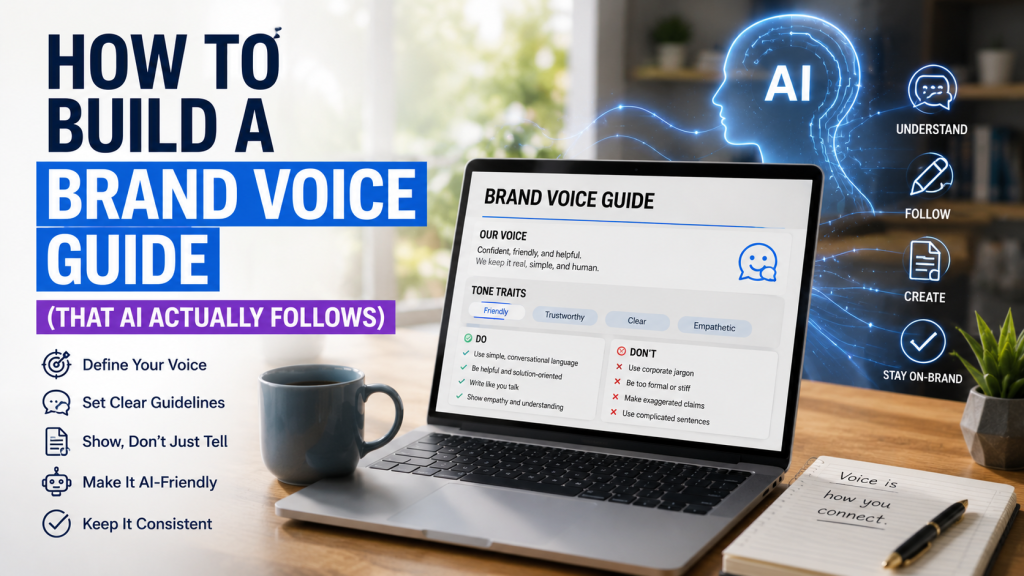
A brand voice guide only works if the thing generating your content can actually read it and act on it. If you’re using AI to produce blog posts, landing pages, or product descriptions at scale, the guide can’t just describe your tone in the abstract. It needs to give the AI concrete instructions: words to use, words to avoid, a specific audience to write for, and examples it can pattern-match against. A brand voice guide built this way does two things at once: it keeps your content consistent for human readers, and it gives AI systems a stable reference point every time they generate something new on your behalf.
Key Takeaways:
- A brand voice guide for AI needs structured fields (tone, audience, keywords to use/avoid), not just descriptive paragraphs
- Vague tone words like “friendly” or “bold” fail unless paired with concrete examples or instructions
- The most useful voice guides are wired directly into your content generation workflow, not stored in a static document
- Testing generated output against the guide regularly is what keeps brand voice consistent over time
- Platforms like ContentSuper apply your voice guide automatically to every AI-generated article through a Brand Profile
What a Brand Voice Guide Actually Needs to Do for AI
A brand voice guide is a reference document that defines how a company sounds: its tone, its vocabulary, its point of view, and the audience it’s speaking to. For years, these guides were written for human writers and editors, people who could infer a lot from context and adjust as they went.
AI doesn’t work that way. A large language model applies whatever instructions it’s given at generation time, and if those instructions are vague, the output drifts. Tell an AI writer your brand is “friendly and professional” and you’ll get generic content that could belong to almost any company. Tell it your brand avoids exclamation points, explains technical terms in plain language, and never uses the word “solutions,” and you’ll get something that actually sounds like you.
That’s the core answer to the question in this article’s title: an AI-ready brand voice guide works when it trades adjectives for instructions. Specificity, not description, is what AI systems execute on.
Why Most Brand Voice Guides Fail With AI Writers
Most brand voice documents were never built with AI content generation in mind, which is why they tend to break down in three predictable ways.
First, they lean on tone words without examples. “Confident,” “approachable,” “expert” are common choices, but none of them tell an AI system what a confident sentence actually looks like versus a hedging one. Second, they rarely include an explicit “avoid” list. Knowing what not to say (jargon, filler phrases, a competitor’s terminology) is often more useful for consistency than knowing what to say. Third, and most practically, these guides live in a PDF or a Google Doc that nobody re-opens once onboarding is done. A guide that isn’t referenced at the point of content generation might as well not exist.
The fix for all three is the same: move from a narrative document to a structured one, and connect it directly to whatever tool is producing your content.
The Core Components of an AI-Ready Brand Voice Guide
An AI-ready brand voice guide generally needs four categories of information, each specific enough that a model can act on it directly.
- Tone of Voice, written as concrete descriptors paired with example sentences, not single adjectives on their own
- Target Audience, specific enough to shape vocabulary and assumed knowledge, not just a broad demographic
- Keywords to Use and Keywords to Avoid, as explicit lists rather than a general impression of “on-brand” language
- Reference details (website, contact info, product names) so AI-generated content stays factually consistent when it mentions the brand
Most SEO practitioners agree that consistency signals matter for both search engines and AI systems: content that repeats the same terminology, tone, and factual details across a domain reads as more authoritative than content that varies wildly page to page. This lines up with Google’s guidance on creating helpful, people-first content, which treats consistency and demonstrated expertise as core signals of trustworthy content, the same principles behind what’s commonly called E-E-A-T.
Turning Tone Descriptors Into Instructions AI Can Execute
Here’s the practical difference between a tone word and an AI-executable instruction.
Vague version: “Our brand voice is bold and direct.” An AI system reading that has almost nothing to work with. Executable version: “Open sections with a direct claim, not a question. Avoid hedging phrases like ‘it could be argued’ or ‘some might say.’ Keep sentences under 20 words where possible.” That’s something a model can actually apply, sentence by sentence.
Brand Voice Instruction: A specific, testable rule for how AI-generated content should read or behave, written so that a model (or a human editor) could check any given sentence against it and get a clear yes or no. Tone descriptors describe a feeling; instructions describe a behavior.
This distinction matters for GEO as well as SEO. When your content sounds consistently like you across dozens of articles, AI Overviews and chat-based assistants have an easier time recognizing your brand as a coherent, citable entity rather than a source that varies from page to page.
Where ContentSuper’s Brand Profile Fits Into This Workflow
This is exactly the structure ContentSuper’s Brand Profile is built around. Instead of storing your voice guide separately from your content generation, the Brand Profile captures Tone of Voice, Target Audience, Keywords to Use, Keywords to Avoid, and contact details (website, phone, email, address) in one place, and applies them automatically to every article generated under that brand.
Because the workspace switcher scopes the entire app to whichever brand is selected, teams managing multiple brands or clients aren’t stuck reapplying voice settings project by project. Set the Brand Profile once, and every new article generated through the SEO/GEO writing tool pulls from it automatically, whether it’s a single article or a batch generated through the Topic Cluster Planner’s bulk generation feature.
For teams that need even finer control, Custom Instructions (available on the Pro and Business plans) let you layer additional per-article guidance on top of the Brand Profile, useful for one-off pieces that need a slightly different angle without touching the base voice settings.
Testing and Refining Your Brand Voice Guide Over Time
A brand voice guide isn’t a one-time setup task. Treat it the way you’d treat any other piece of content infrastructure: something that gets reviewed and adjusted as you learn what works.
A practical cadence looks like this: spot-check a handful of generated articles each month against the guide, note any recurring phrases that feel off-brand, and add them to the Keywords to Avoid list. The emerging consensus in content operations is that voice guides improve fastest when they’re updated based on real generated output, not theoretical edge cases dreamed up in a planning meeting. If you’re using ContentSuper’s AI visibility tool to track how often your brand shows up in AI-generated answers, you’ll also start to see whether consistent voice and terminology correlate with more frequent, more accurate mentions over time.
FAQ
What’s the difference between a style guide and a brand voice guide?
A style guide typically covers mechanical rules: capitalization, punctuation, formatting conventions. A brand voice guide covers tone, vocabulary, and point of view. Both matter for AI-generated content, but the voice guide is what determines whether a piece actually sounds like your brand rather than a generic version of your industry.
How specific should tone of voice descriptions be?
Specific enough that two different people (or two AI generations) would produce similar output from the same instruction. If your tone description could apply to five competitors without changes, it’s too broad. Pair every tone descriptor with at least one example sentence that shows it in practice.
Can AI really maintain brand voice consistently across dozens of articles?
Yes, provided the voice guide is structured and applied automatically rather than manually re-entered each time. Platforms that store the guide as part of a reusable Brand Profile and apply it at generation time see far more consistency than workflows where writers copy-paste tone notes into each new prompt.
Should every brand have its own voice guide, even a small one?
Generally yes. Even a lightweight guide, three or four tone descriptors, a short keywords-to-avoid list, and a one-line audience description, gives AI content generation something concrete to work from. A minimal structured guide outperforms a detailed but purely descriptive one.
Build Your Brand Voice Guide Directly Into Your Content Workflow
A brand voice guide only earns its keep once it’s actually being used at the point where content gets created. Writing one down is the easy part. Connecting it to your content generation process so it’s applied automatically, article after article, is what keeps your brand sounding like itself at scale.
If you’re producing content with AI regularly, it’s worth setting this up once and letting it work in the background rather than re-explaining your tone in every prompt. ContentSuper’s Brand Profile was built for exactly this: define your voice, audience, and keyword preferences once, and every article generated afterward, whether it’s a single SEO piece or a full topic cluster, follows it automatically. Explore the AI Content guide to see how the full workflow fits together, or check the AI Content writing guide and GEO optimize tool for a deeper look at getting your content cited by AI systems, not just ranked by search engines.