
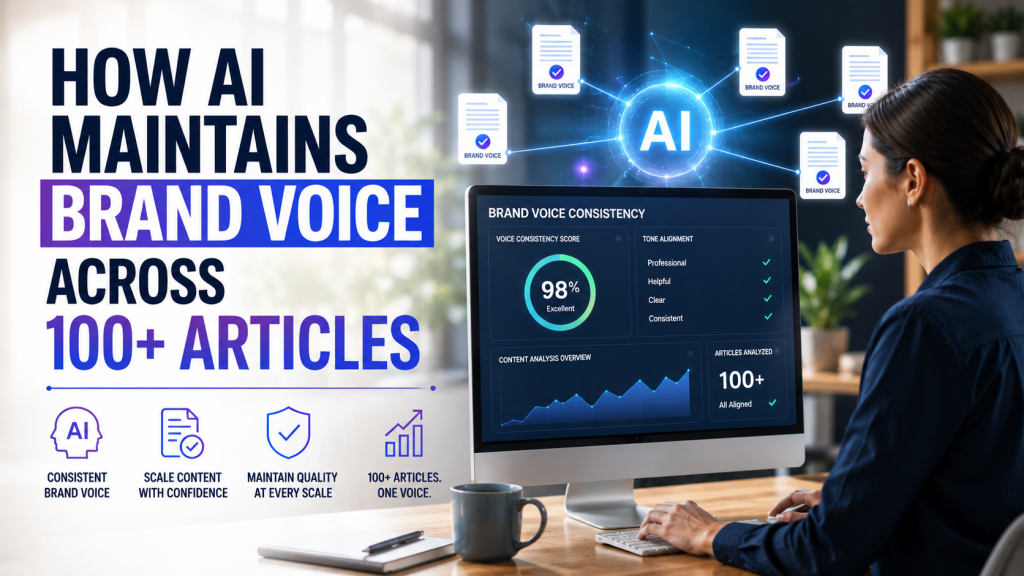
Brand voice consistency at scale comes down to one thing: structured inputs instead of repeated instructions. When AI writes from a saved profile of tone, audience, and keyword rules rather than a fresh prompt each time, article 100 sounds like article one. That’s the short answer. The longer answer involves how that profile gets built, enforced, and applied across different content formats without turning into generic, forgettable copy.
If you’ve ever managed a content calendar with multiple writers, you already know how fast voice drifts. One writer leans formal, another gets chatty, a freelancer misses the memo on which competitor names are off-limits. Multiply that across 100 articles and the brand starts to sound like several different companies. This piece covers how AI-powered content platforms like ContentSuper solve that problem: through a persistent Brand Profile, keyword-level guardrails, format-aware writing, and why voice consistency now matters for AI Visibility, not just traditional SEO.
Key Takeaways:
- Brand voice consistency at scale requires a single, persistent source of truth, not repeated prompting
- A structured Brand Profile (tone, audience, keyword rules) keeps every generated article aligned, regardless of who “writes” it
- Keywords to Use and Keywords to Avoid act as guardrails that prevent off-brand phrasing and competitor mentions
- Format-specific writing instructions let structure vary (how-to, listicle, comparison) while voice stays fixed
- Consistent brand voice increasingly affects AI Visibility: how often AI engines like ChatGPT and Gemini recognize and cite a brand
Why Brand Voice Breaks Down When Scaling Content Production
Most brand voice problems don’t start with bad writing. They start with no shared reference point. A content team with three or four freelance writers might each get a one-paragraph brief: “sound professional but friendly.” That’s not a specification, it’s a vibe, and every writer interprets a vibe differently.
The failure compounds with volume. At 10 articles, inconsistency is a minor annoyance. At 100 articles, it becomes a pattern readers notice: one post is warm and conversational, the next reads like a legal disclaimer. Search engines and AI systems are picking up on this too. Search intent, topical authority, and entity recognition all depend partly on a brand presenting a coherent identity across its content footprint. A brand that sounds different in every article sends mixed signals about who it actually is.
There’s also a cost most teams underestimate: editing time. Without a shared reference, every article needs a voice pass before publishing, which erases most of the time savings that AI-assisted writing was supposed to deliver in the first place.
The Brand Profile: A Single Source of Truth for Voice
The fix is structural, not stylistic. Instead of re-explaining tone in every prompt, a Brand Profile stores the voice specification once and applies it automatically to every article generated afterward. In ContentSuper, this profile includes fields like Tone of Voice, Target Audience, Description, and contact details the AI can embed naturally into content.
Brand Profile: A saved specification of a brand’s tone, audience, and terminology that AI content tools reference on every generation request, ensuring consistent voice without manual re-briefing.
This matters most for teams managing multiple brands or clients. A SEO/GEO writing tool that supports a workspace switcher lets an agency keep separate profiles per client, so switching between a playful DTC brand and a formal B2B SaaS company doesn’t require rewriting instructions every time. Each brand’s voice stays isolated and consistent within its own workspace.
Most content teams that scale successfully agree on this point: the profile has to be reusable and centrally maintained, not scattered across individual prompts or someone’s memory of “how we usually sound.”
Keyword Rules: Precision Control Over What AI Says (and Doesn’t)
Tone alone isn’t enough. A brand also needs control over specific language: terms it wants emphasized and terms it wants avoided entirely. This is where Keywords to Use and Keywords to Avoid function as guardrails rather than suggestions.
Keywords to Use nudge the AI toward terminology the brand actually relies on internally, whether that’s a proprietary feature name or an industry term the brand wants to own. Keywords to Avoid work in the opposite direction: blocking competitor names, discouraged claims, or phrasing that legal or marketing has flagged. This is a meaningfully different mechanism than typing “don’t mention X” into a generic AI chat window, because it persists across every single article without needing to be restated.
This distinction is what separates a structured content platform from an ad hoc AI writing habit. A one-off prompt is a suggestion the model might follow. A saved rule enforced at the Brand Profile level is closer to a constraint the system checks against every time.
Format-Aware Writing Without Losing Voice
Consistency doesn’t mean every article looks identical. A how-to guide, a listicle, and a product comparison all need different structures, and ContentSuper supports nine distinct article formats, each with its own outline and writing instructions. A how-to guide gets step-by-step headings. A comparison article gets a mandatory markdown table for parallel evaluation. A FAQ article structures nearly every H2 as a standalone question.
| Format | Structural signature |
|---|---|
| How-to Guide | Sequential “Step 1, Step 2…” headings |
| Listicle | Numbered items with a “How to Choose” section |
| Comparison / vs | Markdown table for direct side-by-side evaluation |
| FAQ Article | Each H2 is a self-contained question and answer |
What stays fixed across all nine formats is the underlying voice: the same tone, the same audience awareness, the same keyword rules. Structure adapts to the content type. Voice doesn’t. That separation is deliberate, and it’s the reason a brand can produce a technical how-to and a punchy listicle in the same week without either one sounding like it came from a different company.
AI Visibility: Why Consistent Voice Matters Beyond SEO
Traditional SEO has always rewarded topical authority, and consistent voice contributes to that. But there’s a newer reason voice consistency matters: GEO (Generative Engine Optimization), the practice of optimizing content so AI systems like ChatGPT, Gemini, and Perplexity are more likely to cite it directly in generated answers.
The emerging consensus in GEO is that AI systems build a working model of a brand’s identity from the language patterns across its published content. A brand that presents consistent terminology, consistent framing, and a stable point of view across dozens of articles is easier for an AI system to recognize as a coherent entity, and therefore easier to cite confidently.
This is measurable. Tools like ContentSuper’s AI visibility tool track how often a brand actually appears in AI-generated answers across multiple platforms, using tracked prompts that mirror real questions people type into AI assistants. A brand’s AI Visibility Score reflects the percentage of tracked prompts where it shows up. For a deeper walkthrough of how AI visibility ties into a broader content strategy, ContentSuper’s AI Content guide covers the full picture, and the GEO optimize tool breaks down specific optimization tactics brand by brand.
According to Search Engine Journal’s ongoing coverage of AI search behavior, brand mentions in AI-generated answers increasingly influence discovery in ways comparable to traditional organic rankings. Voice consistency isn’t just a branding nicety anymore. It’s part of how a brand becomes recognizable to the systems now mediating a growing share of information discovery.
FAQ
Does AI-written content sound robotic across many articles?
Not when it’s generated from a structured Brand Profile rather than isolated prompts. Robotic-sounding AI content usually comes from generic prompting with no persistent tone, audience, or keyword guidance. When those parameters are saved and applied consistently, the output reflects a specific, recognizable voice rather than default AI phrasing, and it stays that way whether it’s article 1 or article 150.
Can different team members maintain the same brand voice?
Yes, because the voice specification lives in the Brand Profile rather than in any individual’s head. A marketing lead, a freelance contributor, or an agency account manager can all generate content for the same brand and get output governed by the same tone, audience targeting, and keyword rules. This removes the dependency on one “voice expert” reviewing every article before it ships.
What happens if I update my Brand Profile after publishing articles?
Previously published articles aren’t retroactively rewritten, but every new article generated after the update reflects the revised profile immediately. This makes it straightforward to evolve a brand’s voice over time, for example shifting from a more formal tone to a more conversational one, without having to manually rebrief every future writer or contributor.
Can I manage multiple brand voices in one account?
Yes. A workspace switcher lets one account maintain separate Brand Profiles for different brands or clients, each with its own tone, audience, and keyword rules. This is particularly useful for agencies producing content across several client accounts, since switching context doesn’t require re-explaining voice guidelines each time.
Write On-Brand Content at Scale with ContentSuper
Brand voice consistency across 100+ articles isn’t a matter of finding better writers or writing longer style guides. It’s a matter of building the voice specification once and letting a structured system apply it every time. That’s what a Brand Profile is designed to do: capture tone, audience, and keyword rules once, then enforce them automatically across every format, every topic, and every contributor.
If you’re producing content at any real volume, whether that’s for one brand or several client accounts, ContentSuper’s AI Content writing guide is a solid next step, or you can head straight to the platform and set up a Brand Profile to see how voice consistency holds up across your next batch of articles.