
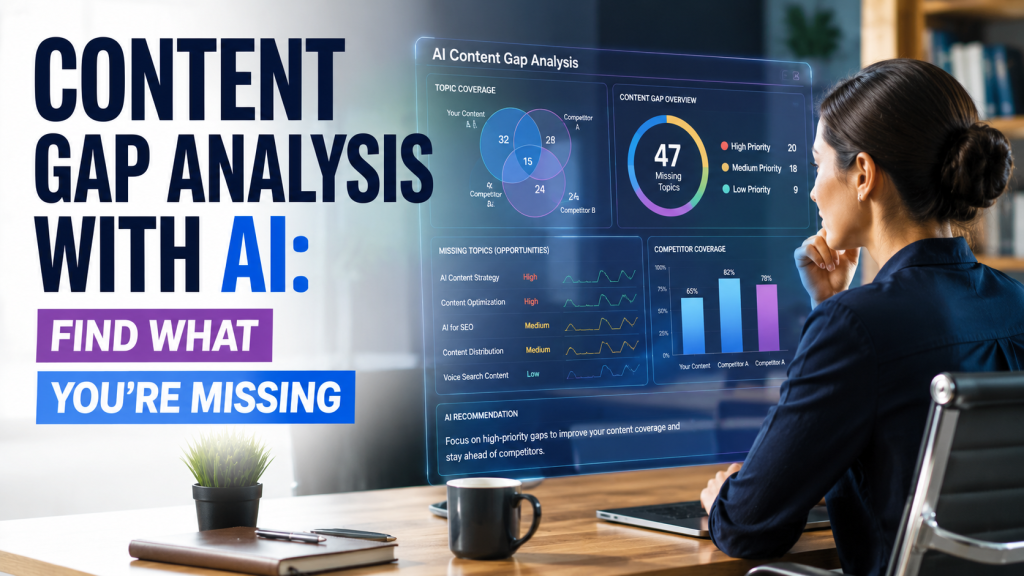
Content gap analysis is the process of identifying topics, keywords, and questions your audience is searching for that your website doesn’t answer yet, or doesn’t answer well. Traditionally that meant comparing your content against competitors in a spreadsheet. Today it means something bigger: finding the gaps between what you publish and what AI engines like ChatGPT, Gemini, and Perplexity actually cite when someone asks about your category. If you’ve been ranking fine on Google but never come up when a customer asks an AI assistant for a recommendation, you have a gap that traditional SEO tools were never built to catch. This guide walks through how to find both kinds of gaps and close them systematically.
Key Takeaways:
- Content gap analysis now covers two layers: missing SEO topics and missing AI visibility
- A “gap” isn’t just an unwritten article, it can be a topic you’ve covered that AI engines still don’t cite you for
- Topic clusters (pillar page plus satellite articles) give you a structured way to spot and prioritize gaps
- AI visibility checks reveal gaps that keyword tools can’t, specifically where you rank but aren’t mentioned in AI answers
- Closing gaps works best as an ongoing cycle, not a one-time audit
What Content Gap Analysis Actually Means (and Why AI Changes It)
At its core, content gap analysis answers one question: what is your audience looking for that you haven’t given them yet? That could be a missing blog post, a thin page that doesn’t fully answer a search query, or a subtopic competitors cover and you don’t.
What’s changed is the definition of “audience.” People no longer only type queries into Google. They ask ChatGPT to compare tools, ask Perplexity for a recommendation, or ask Gemini to summarize a category. Each of those interactions is a moment where your brand either gets mentioned or gets skipped, regardless of whether you rank on page one.
That’s why a modern gap analysis has to look at two separate signals: search visibility and AI visibility. Most SEO practitioners agree that keyword gaps still matter for driving organic traffic, but treating AI citation gaps as an afterthought means missing a growing share of how people actually discover brands now.
The Two Types of Gaps You’re Probably Missing
It helps to separate these explicitly, because they require different fixes.
| Gap Type | What It Looks Like | How You Find It |
|---|---|---|
| SEO content gap | A topic, keyword, or subtopic you haven’t published on, or covered thinly | Keyword research, competitor content audits, search console data |
| AI visibility gap | A topic where you rank or have relevant content, but AI engines don’t cite or mention your brand in generated answers | Tracking real user prompts across ChatGPT, Gemini, Claude, and Perplexity, then checking whether your brand appears |
A page can rank on page one and still lose every AI-generated answer to a competitor who structured their content in a way large language models prefer to cite. That’s not a keyword problem. It’s a GEO (Generative Engine Optimization) problem, and it needs its own detection process.
GEO gap, short for Generative Engine Optimization gap, refers to a topic where a brand has adequate or even strong search visibility but is absent or rarely mentioned in AI-generated answers, chat responses, or AI Overviews for related queries.
How to Run a Content Gap Analysis Step by Step
A practical gap analysis follows three passes, each building on the last.
Step 1: Audit what you already have. Pull a full list of your published articles and group them by topic. Look for pillar topics with only one or two satellite pages around them, that’s usually a sign of thin topical coverage rather than a genuine gap.
Step 2: Compare against competitor coverage. Identify who ranks or gets cited for your target topics and note which subtopics they cover that you don’t. This is standard competitive analysis, but it’s worth doing per-cluster rather than per-keyword, since AI engines tend to reward topical completeness over isolated keyword targeting.
Step 3: Cross-check AI visibility. Run your highest-priority topics as prompts against ChatGPT, Gemini, Claude, and Perplexity and check whether your brand shows up. A topic marked “Not visible” even after you’ve published content on it is a gap that a keyword tool alone would never surface, since it has nothing to do with rankings and everything to do with how AI models are choosing sources.
Using Topic Clusters to Systematize Gap-Finding
Gap analysis gets messy fast when you’re tracking it manually across spreadsheets. A topic cluster structure, one central pillar page surrounded by supporting satellite articles, turns gap-finding into something closer to a checklist than a guessing game.
Map out your pillar topic, then list every satellite subtopic a comprehensive resource on that subject should cover. Any subtopic without a published article is an explicit gap, visible at a glance rather than buried in keyword data. This is the same logic behind ContentSuper’s AI content guide, which frames topical completeness as a prerequisite for AI citation, not just search rankings.
Once gaps are mapped, closing them at scale is the harder part. Writing satellite articles one at a time works for small gaps, but a cluster with ten or fifteen missing pages needs a faster path, generating outlines and drafts for multiple gap topics in sequence rather than starting from a blank page each time.
Where AI Visibility Fits Into Gap Analysis
AI visibility tracking works by sending real prompts, the kind actual users type into AI assistants, to multiple platforms and checking whether your brand appears in the response. Each prompt returns a status: visible or not visible, along with which platforms mentioned you and which competitors showed up instead.
This data does two things for gap analysis. First, it flags topics where you’re invisible to AI engines even with existing content, which tells you the content needs restructuring for GEO rather than a brand-new article. Second, competitor visibility comparisons show which rival brands are winning AI citations on shared topics, which is often a stronger signal of a real content gap than keyword volume alone.
Tools like ContentSuper’s AI visibility tool track this directly, running prompts against ChatGPT, Gemini, Claude, and Perplexity and reporting an AI visibility score alongside a source list showing exactly which pages AI models cited when they did mention a competitor. That source list is often the fastest way to reverse-engineer what a “gap-free” page needs to include.
Common Content Gap Mistakes to Avoid
A few patterns show up repeatedly in gap analyses that miss the mark.
Chasing keyword volume without checking search or AI intent leads to content that technically covers a topic but doesn’t match what the searcher actually wants, which AI models are quick to skip when selecting sources. Treating AI citation gaps as secondary to keyword gaps is another common mistake. According to Search Engine Journal’s 2024 coverage of AI search behavior, a growing share of research queries now happen inside AI assistants rather than traditional search, which means a keyword-complete site can still lose visibility where it increasingly counts.
The last mistake is treating gap analysis as a one-time project. Competitor content updates constantly, and AI models retrain and re-crawl on their own schedules, so a topic that was fully covered six months ago can quietly become a gap again without any change on your end.
FAQ
What’s the difference between a content gap and a keyword gap?
A keyword gap is a specific search term you don’t rank for. A content gap is broader: it includes missing topics, thin coverage, and now AI visibility gaps where you have relevant content but AI engines still don’t cite you. Every keyword gap is a content gap, but not every content gap starts with a missing keyword.
How often should I run a content gap analysis?
Quarterly is a reasonable baseline for most brands, with AI visibility checks run more frequently since AI-generated answers shift faster than organic search rankings. High-competition categories often benefit from monthly checks on their most important topic clusters.
Can AI tools find content gaps automatically?
Yes, to a meaningful degree. AI-assisted tools can compare your published content against a topic cluster structure and flag missing satellite pages, and separately can run tracked prompts against AI assistants to flag topics where your brand isn’t being cited. Neither replaces judgment entirely, but both cut the manual research time significantly.
Does content gap analysis help with AI Overviews and ChatGPT visibility?
Yes. Closing an AI visibility gap usually means restructuring content for direct-answer clarity, adding named entities and specific claims, and covering a topic completely enough that an AI model treats the page as a reliable source. That’s the same work that improves eligibility for AI Overviews and citation in tools like ChatGPT and Perplexity.
Close the Gaps with ContentSuper
Finding gaps is only useful if you can close them without it becoming a full-time job. ContentSuper’s Topic Cluster Planner maps pillar and satellite structure automatically, flags missing subtopics, and lets you generate multiple gap-filling articles in sequence instead of one at a time. Pair that with the AI Visibility Checker to see exactly which topics you’re missing in AI-generated answers, not just search results, and you get a gap analysis that covers both halves of how people actually find brands today.
If you’re not sure where to start, ContentSuper’s own SEO/GEO writing tool can generate a first draft for any gap you identify, grounded in your brand profile and internal linking structure. And if AI visibility is the bigger blind spot, the AI SEO content writing guide and GEO optimize tool are good next stops for turning existing content into something AI engines are more likely to cite.