
What Is an AI Visibility Score, Exactly?
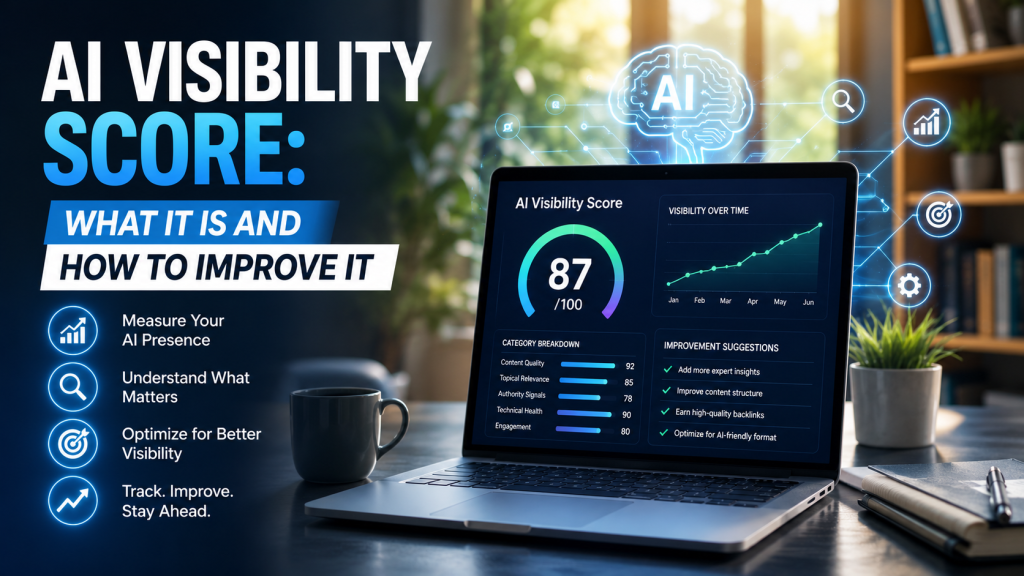
An AI Visibility Score is the percentage of tracked prompts where your brand actually shows up in an AI-generated answer. When someone asks ChatGPT, Gemini, Claude, or Perplexity a question related to your product or industry, the score tells you how often you’re part of that answer and how often you’re invisible.
This is a different kind of measurement than anything SEO has used before. Traditional SEO tracks rankings, impressions, and click-through rates on a search results page. An AI Visibility Score tracks something more direct: whether an AI system chose to mention you at all when generating a response. There’s no page to rank on. There’s just an answer, and you’re either in it or you’re not.
Key Takeaways:
- AI Visibility Score measures the percentage of tracked AI prompts where your brand appears in the generated answer
- It spans multiple platforms, including ChatGPT, Gemini, Claude, and Perplexity, each with its own visibility rate
- The score is calculated from real prompts checked on a recurring schedule, not a one-time snapshot
- Competitor benchmarking matters more than chasing a perfect score in isolation
- Improving your score requires GEO-specific tactics, not just traditional SEO work
We built the AI visibility tool because this gap between SEO performance and AI presence is becoming one of the biggest blind spots in modern marketing. You can rank on page one and still be completely absent from the answers AI assistants give.
Why AI Visibility Score Matters Now
Buyer behavior has shifted faster than most marketing teams have adjusted to. A growing share of research and purchase decisions now start with a question typed into an AI assistant rather than a search bar. When that happens, there’s no scroll, no list of ten blue links, no second page to click into. There’s one answer, and a handful of brands named inside it.
This creates real zero-click risk. If an AI assistant answers a user’s question completely, using information pulled from your website or a competitor’s, the user may never visit either site. They get what they need and move on. For brands that aren’t mentioned in that answer, the opportunity disappears before it ever had a chance to convert.
Most SEO practitioners agree that this shift represents a structural change, not a temporary trend. Search Engine Journal, Gartner, and other industry sources have all pointed to declining organic click-through rates as AI-generated answers absorb more query volume. Being cited inside those answers is becoming a new form of top-of-funnel visibility, and it operates by different rules than classic search ranking.
How the AI Visibility Score Is Calculated
The score starts with a set of prompts, real questions that actual customers would type into an AI assistant when researching your category. Each prompt gets checked against the AI platforms you’ve selected. If your brand shows up in the generated answer, that prompt counts as a hit. The score is simply the share of checked prompts where your brand appeared.
A few related metrics round out the full picture:
Platform Coverage refers to how many of the tracked AI platforms (ChatGPT, Gemini, Claude, Perplexity) mention your brand for a given topic, versus how many return an answer with no mention of you at all.
Beyond the score itself, most AI Visibility dashboards track Mentions (the raw count of times your brand appeared, broken out by platform), Sources (the specific URLs an AI model cited when it named your brand), and a Competitor Visibility comparison that shows your visibility percentage stacked directly against rivals in the same answers.
The score also isn’t static. It’s tracked as a time-series, plotted across days and weeks, so you can see whether visibility is trending up, holding steady, or slipping as competitors publish new content and AI models refresh their underlying data.
What a “Good” AI Visibility Score Looks Like
There’s no universal benchmark that applies to every industry, and treating the score as a pass/fail number misses the point. A niche B2B category with three real competitors will naturally produce a different visibility ceiling than a crowded consumer market with dozens of brands vying for the same AI-generated answer.
What matters more is relative position. If your AI Visibility Score is 40% but your closest competitor sits at 15%, you’re winning the category even though the raw number isn’t close to 100%. If you’re at 60% but a competitor is at 85%, there’s a real gap worth closing, regardless of how strong 60% might look on paper.
This is where competitor benchmarking becomes essential rather than optional. Side-by-side visibility comparisons reveal not just who’s ahead, but which specific prompts you’re losing on, which is far more actionable than a single aggregate percentage.
How to Improve Your AI Visibility Score
Improving AI visibility is not the same exercise as improving a Google ranking. It requires content built specifically for how large language models pull, weigh, and cite information, a discipline generally referred to as GEO, or Generative Engine Optimization.
A few tactics consistently move the needle:
Write in direct-answer format. When a heading poses a question, the first sentence underneath it should answer that question plainly. AI models tend to lift the clearest, most self-contained answer available, so burying the point three sentences deep reduces your odds of being the one quoted.
Use entity-rich, specific language. Name the tools, standards, and concepts relevant to your space instead of describing them vaguely. AI models are pattern-matching against named entities, and content that speaks in generalities gives them less to latch onto.
Build topical authority through content clusters. A single strong page rarely earns durable AI visibility on its own. A pillar page supported by a cluster of related articles signals depth on a topic, which both traditional search engines and AI models weigh heavily when deciding what to cite. ContentSuper’s AI content guide walks through how cluster structure supports this kind of topical depth at scale.
Get cited on high-trust third-party sources. AI models frequently pull from sources beyond your own site, including review platforms, industry publications, and comparison pages. Earning mentions there indirectly strengthens your visibility inside AI-generated answers, since models often triangulate across multiple sources before naming a brand.
Keep your SEO foundation intact. GEO doesn’t replace SEO, it builds on it. Search Engine Land has noted that a technically sound, well-structured site remains a prerequisite for AI crawlers to reliably access and understand your content in the first place. For teams building this foundation from scratch, ContentSuper’s AI SEO content writing resource covers how SEO and GEO fit together in a single workflow, and the GEO optimize tool is built specifically to close that gap.
Tracking and Monitoring Your Score Over Time
None of these tactics matter if you’re not measuring whether they’re working. The first step is building a prompt list that mirrors real buyer language, not marketing language. “Best project management software for remote teams” reflects how someone actually searches; “innovative collaboration solutions” doesn’t.
From there, checks should run on a recurring basis rather than as a one-off audit. AI models update frequently, competitors publish new content, and visibility can shift within weeks. A prompt that showed your brand last month might not this month, and tracking the change (whether it’s trending Up, Down, Stable, or Lost) tells you exactly where to focus content efforts next.
Suggesting and adding new prompts as your product or market evolves keeps the tracking list current. A stale set of five prompts from a year ago won’t reflect how AI assistants are actually being asked about your category today.
Frequently Asked Questions
What counts as a “mention” for AI Visibility Score?
A mention is counted whenever an AI system names your brand directly in its generated answer to a tracked prompt. This includes cases where your brand is listed among several options and cases where it’s the sole recommendation. The specific wording doesn’t need to match exactly, but the AI’s answer must clearly reference your brand by name.
How often should I check my AI Visibility Score?
Most teams check weekly or biweekly, since AI models refresh their underlying data on their own schedules and visibility can shift without any change on your end. Checking too infrequently means you miss the connection between a content update and a resulting change in your score, which makes it hard to know what’s actually working.
Can a low AI Visibility Score hurt my traditional SEO?
Not directly, since AI visibility and organic search rankings are measured separately. However, the underlying content quality, structure, and topical authority that improve AI visibility tend to strengthen traditional SEO signals too, so the two generally move in the same direction over time rather than working against each other.
Is AI Visibility Score the same across all AI platforms?
No. ChatGPT, Gemini, Claude, and Perplexity each pull from different underlying data sources and weigh signals differently, so it’s common to see strong visibility on one platform and near-zero visibility on another. Tracking platform-level breakdowns, not just the blended score, shows you exactly where the gap is.
Start Tracking and Improving Your AI Visibility Score
Guessing whether your brand shows up in AI-generated answers isn’t a strategy, it’s a blind spot. The AI Visibility Score gives you an actual number to work from, along with the platform-level and competitor-level detail needed to know where to focus next.
ContentSuper pairs that tracking with the content workflow needed to act on it: GEO-optimized articles, pillar pages, and topic clusters built to earn the kind of citations AI models look for. If you’re ready to see where your brand currently stands, ContentSuper’s SEO/GEO writing tool is the place to start, and pairing it with AI Visibility tracking closes the loop between publishing content and knowing whether it’s actually working.