
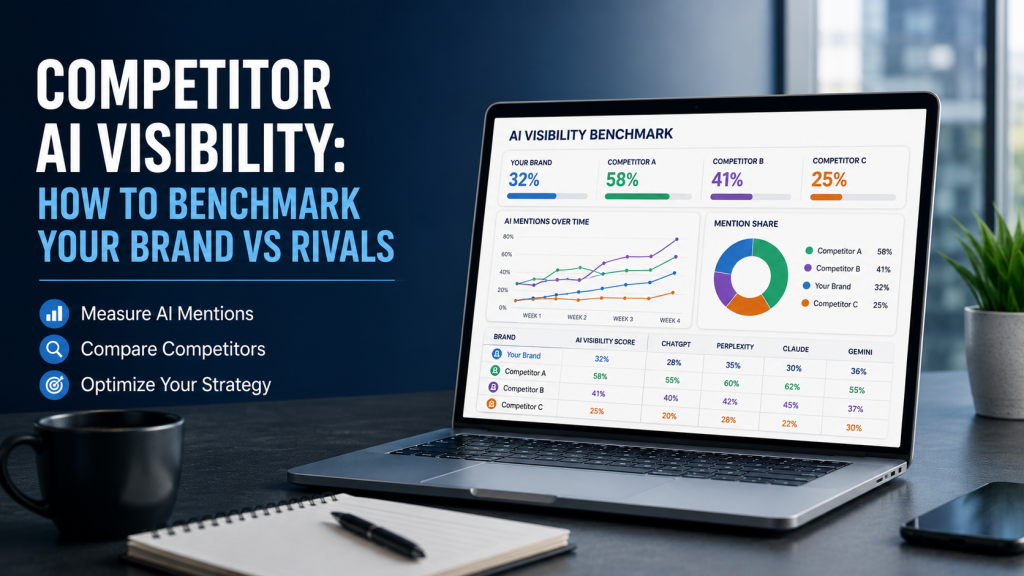
Knowing your own AI visibility score feels good. But if your biggest competitor is showing up in 80% of AI-generated answers while you’re sitting at 40%, that score means something very different than if your closest rival is at 20%. Competitor AI visibility benchmarking shifts the question from “are we visible?” to “are we winning the AI conversation in our category?” That distinction matters more than most brands realize, and it matters right now, before AI search cements the pecking order in your niche.
This article walks through what competitor AI visibility actually measures, how to set up a proper benchmarking process, and how to act on the data once you have it.
Key Takeaways:
- Your absolute AI visibility score only tells part of the story; competitor comparison reveals your real position in AI-generated answers
- LLMs surface brands based on signals like topical authority, entity consistency, and content that gets cited in training data and RAG retrieval
- ContentSuper automatically detects which competitors appear alongside your brand in AI answers, giving you side-by-side comparison data
- Declining CHANGE indicators (“Down” or “Lost”) are early warnings that a competitor is displacing you in specific prompt categories
- Closing the visibility gap requires a content strategy that feeds both traditional SEO signals and AI citability simultaneously
Why Your Brand’s AI Visibility Score Doesn’t Tell the Whole Story
A score on its own is context-free. If your brand appears in 50% of the prompts you track, that feels like a decent result, but decent compared to what? If three competitors each appear in 70-85% of the same prompts, you’re actually losing significant ground in the AI conversation that shapes purchase decisions in your category.
AI search is increasingly functioning like a recommendation engine. When someone asks ChatGPT, Gemini, or Perplexity which tool, service, or brand to choose, the model doesn’t list every option in the market. It selects a short set of names it considers relevant and credible based on what it has been trained on and what content it retrieves at the moment of the query. Being on that shortlist is everything. Being off it while a competitor is on it consistently is a structural disadvantage that compounds over time.
Share of voice has always been a useful concept in traditional marketing. The AI-native version of share of voice is your mention rate relative to competitors across AI platforms, measured across a consistent set of user prompts. That’s the benchmark that tells you whether your brand is growing or shrinking inside the AI conversation that matters.
What Competitor AI Visibility Actually Measures
Competitor AI visibility is the side-by-side comparison of how often your brand versus named rivals appear in AI-generated answers to the same set of prompts, across platforms like ChatGPT, Gemini, Claude, and Perplexity.
Competitor AI Visibility defined: The comparative measurement of how frequently competing brands appear in AI-generated answers to the same category-relevant prompts, expressed as a percentage of prompts where each brand is mentioned across one or more AI platforms.
Three core metrics make up a useful competitor benchmark:
Mention rate is the percentage of tracked prompts where your brand (or a competitor) appears in the AI response. This is the primary competitive signal.
Platform coverage tracks how many of the major AI platforms your brand appears on for a given prompt. A competitor visible on ChatGPT, Gemini, and Perplexity simultaneously has broader coverage and therefore higher resistance to platform-specific algorithm changes.
Source citations are the URLs that AI systems link to when mentioning a brand. More cited sources, particularly from authoritative domains, indicates the brand’s content is being retrieved and trusted during RAG (Retrieval-Augmented Generation) lookups.
LLMs don’t rank brands arbitrarily. They surface brands whose content appears frequently in training data and in real-time retrieval, whose entity information is consistent across web sources, and whose content clearly answers the questions users are asking. Understanding this helps explain why some brands punch above their apparent size in AI visibility, and why others with large traditional SEO footprints still underperform in AI-generated answers.
How to Identify the Right Competitors to Benchmark Against
Your AI competitors and your traditional SEO competitors are not always the same list. A brand that ranks below you on Google might still appear far more consistently than you do in AI answers, simply because their content is more structured, more citable, or more topically focused.
The right competitors to benchmark are the brands that appear alongside you (or instead of you) when someone asks an AI about your product category. This is a meaningful distinction: you want to know who the AI considers relevant to your space, not just who you consider a market rival.
ContentSuper’s AI Visibility tool handles this automatically. When you run a check on any tracked prompt, the system scans the AI’s response not just for your brand but for any competitor brands mentioned in the same answer. Those co-mentions are captured and tracked over time in the Competitor Visibility dashboard. You don’t need to manually specify who your competitors are at setup, because the AI tells you who it considers your peers.
That said, it’s worth building a deliberate competitor list. Pull your top 10-15 category prompts, run them manually in ChatGPT and Perplexity, and note every brand name that appears in the responses. Cross-reference that list against your actual market competitors. The overlap is your primary benchmark group. Brands that appear in AI answers but weren’t on your radar as competitors deserve a closer look, because they’re already in the conversation you’re trying to win.
Setting Up Your Competitor Visibility Benchmark in ContentSuper
ContentSuper’s competitor tracking lives inside each Brand Profile, accessible from the sidebar under Competitors when you’re in the relevant brand workspace.
The setup is passive by design. Once you’ve added prompts to track and run your first AI visibility checks, ContentSuper automatically logs which competitor brands appear in the same AI responses as your brand. Those brands populate your Competitor Visibility chart without manual data entry.
The Overview tab is where the competitive picture comes together. The Competitor Visibility section displays a horizontal bar chart comparing your brand’s visibility percentage against each detected competitor, across the full set of prompts you track. At a glance, you can see where you lead, where you’re close, and where a competitor has a meaningful advantage.
For each tracked prompt, the CHANGE column is particularly useful for competitive analysis. “Stable” means your position relative to competitors hasn’t shifted. “Down” means a competitor has started appearing where you previously did, or your appearance rate has dropped while theirs held. “Lost” means you’ve dropped out of AI responses for that prompt category entirely. These signals are early warnings, not post-mortems. If you catch a “Down” signal early, you have time to act on the content gap before “Lost” becomes a pattern. Using the AI visibility tool gives you the infrastructure to catch these shifts as they happen rather than discovering them weeks later.
Reading the Data: What Good vs Bad Competitive Position Looks Like
A strong competitive position in AI visibility looks like a consistent mention rate above your primary rivals across a broad range of prompts, with stable or improving CHANGE indicators and citations from multiple authoritative sources.
Here’s a practical interpretation framework:
| Signal | What It Means | Priority |
|---|---|---|
| Your mention rate > rival by 20%+ | Solid lead; maintain content cadence | Monitor |
| Rates within 10% of each other | Contested ground; small moves matter | Improve |
| Rival rate > yours by 20%+ | Structural gap; content strategy review needed | Act now |
| “Lost” on 2+ prompts in same category | Competitor displacement in progress | Urgent |
| Your platform coverage is narrower | Higher risk from platform-specific changes | Diversify |
According to findings shared by Semrush in their 2024 AI search behavior analysis, brands with consistent entity mentions across multiple authoritative domains are 2-3x more likely to appear in AI-generated recommendation responses than brands with equivalent domain authority but fragmented entity signals. This matters for how you interpret your competitor data: a rival outperforming you in AI visibility may have an entity consistency advantage that no amount of additional blog posts will fix without also addressing how your brand is described across the web.
The goal isn’t to match a competitor on every prompt. It’s to identify the highest-value prompt categories for your business, assess your position in those specifically, and close the gap where it costs you most.
How to Close the AI Visibility Gap on Your Competitors
Improving your AI visibility relative to competitors requires working on two fronts simultaneously: creating content that AI systems retrieve as credible, and ensuring your brand’s entity information is consistent enough to be recognized reliably.
On the content side, the GEO optimize tool from ContentSuper helps you structure articles so they meet the citability signals that LLMs look for: direct-answer introductions, FAQ sections formatted for featured snippet extraction, clearly attributed claims, and definition blocks that AI systems can lift as standalone factual statements. Every piece of GEO-optimized content you publish is a potential retrieval asset when an AI processes a user query in your category.
On the entity side, the most common gap is inconsistency. If your brand name appears differently across your website, your LinkedIn profile, industry directory listings, and third-party reviews, LLMs may not reliably connect those references to a single entity. Auditing and standardizing how your brand name, product names, and category descriptors appear across the web is unglamorous work but it has a disproportionate effect on AI mention rates.
Platform behavior varies. Perplexity leans heavily on real-time web retrieval, so freshly published, well-structured content moves the needle faster there. ChatGPT’s responses are influenced more by training data patterns, meaning older, higher-authority content and consistent brand mentions across trusted publications carry more weight. Gemini falls somewhere in between, with strong weighting toward content indexed by Google. A competitor benchmarking practice helps you notice which platforms you’re losing on first, so you can direct effort appropriately rather than spreading it evenly.
The AI Content writing guide covers the content production side of this in more depth, including how to build a publishing cadence that improves both traditional SEO rankings and AI citability simultaneously.
You can also use ContentSuper’s SEO/GEO writing tool to produce the content that feeds your AI visibility, making the loop between content creation and visibility measurement tighter and more actionable. Read the AI Content guide for a full picture of how both capabilities work together.
FAQ
What is competitor AI visibility and why does it matter?
Competitor AI visibility is the measurement of how often rival brands appear alongside or instead of your brand in AI-generated answers to category-relevant prompts. It matters because AI systems like ChatGPT, Gemini, and Perplexity are increasingly where purchase decisions begin. If your competitors appear in those answers and you don’t, you’re effectively absent from a growing channel that your potential customers are actively using to discover and evaluate options in your market.
How often should I benchmark my brand against competitors?
Most practitioners find a weekly check cadence sufficient for active monitoring, with a deeper review monthly to assess trend patterns. The CHANGE column in ContentSuper’s prompt table makes weekly spot-checks efficient: you’re primarily looking for “Down” or “Lost” signals that indicate a competitor is gaining ground on specific prompts. Monthly reviews are better for reassessing your overall competitive position and adjusting your content strategy.
Can a small brand outrank bigger competitors in AI answers?
Yes, and this is one of the more interesting dynamics of AI search. LLMs don’t rank brands by company size or advertising spend. They surface brands whose content is well-structured, topically comprehensive, and consistently cited across trustworthy sources. A smaller brand that publishes authoritative, GEO-optimized content in a focused niche can appear in AI answers far more consistently than a larger competitor whose content is broad but shallow or poorly structured for AI retrieval.
What’s the difference between AI visibility and traditional SEO share of voice?
Traditional SEO share of voice measures how much of the total search traffic for a set of keywords a brand captures, typically tracked through rank position data. AI visibility share of voice measures how often a brand appears in AI-generated responses to conversational prompts, regardless of keyword rank. A brand can have strong SEO share of voice but low AI visibility if its content isn’t structured for AI retrieval. The metrics are complementary, not interchangeable, and both are worth tracking in 2025 and beyond.
Start Benchmarking Your AI Visibility Before Your Competitors Do
The brands that build competitive AI visibility benchmarking into their workflow now are accumulating a data advantage that gets harder to close over time. Every month of visibility data tells you which prompts are contested, which platforms you’re underperforming on, and which competitors are actively displacing you in AI answers. That data doesn’t exist until you start tracking.
ContentSuper’s AI Visibility tool is built for exactly this: tracking your prompts, detecting competitor co-mentions automatically, and giving you the side-by-side comparison data you need to make content decisions that move the needle. Pair it with ContentSuper’s content writing tools and you have a complete loop from visibility gap to published content to improved mention rate.
Start with your ten most important category prompts. Run the first check. See where you stand relative to your rivals. Then you’ll know exactly where to focus.