
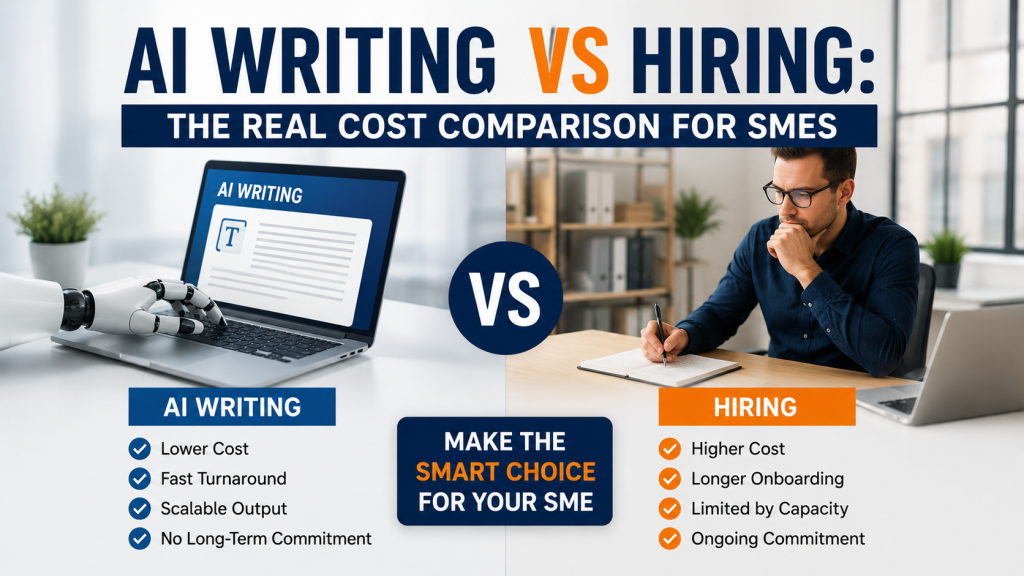
Most small business owners know content matters. What they don’t know, until they’ve tried both, is how different the economics are between hiring a writer and using AI. This article runs the numbers honestly, looks at where quality trade-offs show up, and gives you a framework to make the right call.
Key Takeaways:
- Hiring a freelance writer typically costs $50 to $300+ per article, while AI tools can bring that figure below $1 per article at scale
- ContentSuper’s Pro plan covers 30 articles per month for $26, roughly $0.87 per article
- AI writing tools excel at SEO content at scale; human writers still add value for investigative, interview-based, or highly niche pieces
- GEO (Generative Engine Optimization) means your content needs to perform in AI-generated answers, not just Google rankings, a dimension most human writers aren’t optimizing for
- The real ROI question isn’t “AI or human?” but “what combination makes sense at my content volume and budget?”
What SMEs Actually Spend on Content (And Why It Adds Up Fast)
Content costs have a way of being underestimated. You budget for the writing fee, but the real expenditure is much wider.
A full-time junior content writer in most markets runs $3,000 to $5,000 per month before benefits, taxes, and onboarding overhead. Freelancers feel cheaper upfront, rates for a competent SEO writer typically land between $50 and $300 per article depending on length, expertise, and market. But freelancers come with their own overhead: briefing documents, back-and-forth revisions, deadline management, and the inconsistency of working with multiple writers who each have a different grasp of your brand voice.
Then there’s the cost of slow. A writer who takes four to seven days per article makes your content calendar a bottleneck. Every week a page isn’t live is a week it isn’t indexing or accumulating backlinks. For an SME trying to build topical authority, slow content velocity is a compounding disadvantage.
For a typical SME publishing four to eight articles per month, freelance costs alone run $400 to $2,400 monthly, before accounting for editing, SEO review, or the internal time spent managing the process.
How AI Writing Changes the Cost Equation
An AI Content writing guide will tell you that AI writing tools don’t just speed things up, they restructure the whole production workflow. Instead of brief → writer → draft → revisions → edits → publish, AI collapses that into: input title and keywords → generate outline → write full article → review and publish.
Speed is the most visible change. ContentSuper generates a structured outline in seconds and a full 1,500-word article in under a minute. That same article takes a freelancer one to three days from briefing to final draft.
Cost per article is where the math becomes hard to ignore. At $100 per freelance article, four posts per month costs $400. At ContentSuper’s Pro tier ($26/month for 30 articles), the cost per article falls below $1. That’s not a marginal improvement.
The trade-off isn’t zero. AI writing requires human review for factual accuracy, particularly in regulated industries or niche technical topics. But for SMEs producing standard SEO content, how-to guides, product explainers, comparison articles, local SEO pages, the quality ceiling is high enough that review is a light lift rather than a rewrite.
ContentSuper Pricing: What SMEs Actually Pay
ContentSuper’s pricing is structured to fit businesses at different content volumes, and the cost-per-article math at each tier is worth spelling out clearly.
| Plan | Monthly Cost | Articles | Cost per Article |
|---|---|---|---|
| Free Trial | $0 (7 days) | 3 total | Free |
| Starter | $12 | 10 | $1.20 |
| Pro | $26 | 30 | $0.87 |
| Business | $49 | Unlimited | Effectively $0 |
The Starter plan at $12/month covers one brand profile and ten articles, right-sized for a solo founder or a small brand testing the channel. Pro at $26/month gives you three brand profiles and 30 articles, which covers most SME content calendars without pushing into enterprise budgets. Business at $49/month removes article and brand limits entirely, which makes sense once content production becomes a core growth lever.
All paid plans include AI Visibility tracking, which matters more than most SME owners realize (more on that in the next section). The free trial gives you seven days and three articles with no credit card required, enough to genuinely test the output quality before committing.
The Quality Question: Does AI Writing Hold Up?
This is the question every skeptic asks first, and it’s a fair one. AI writing in 2024 and 2025 is not what it was two years ago, but it’s also not a plug-and-play replacement for a skilled senior writer on complex editorial work.
Where AI performs well: structured SEO content, how-to articles, product descriptions, comparison pages, FAQ-heavy content, and cluster articles built around a defined keyword strategy. For this category of content, which represents the majority of an SME’s content needs, the output quality from a well-configured AI tool is production-ready with light editing.
What makes the difference is configuration. ContentSuper uses Brand Profiles to store your tone of voice, target audience, keywords to use, keywords to avoid, and business context. When the AI writes with that profile active, it’s not producing generic output, it’s producing content shaped to your brand’s positioning. Custom instructions let you layer on specifics: preferred writing style, topics to emphasize, sections to always include.
Where human review still matters: any content making specific factual claims that need verification, pieces requiring local market knowledge, and anything involving interviews, proprietary data, or your company’s unique internal expertise. AI doesn’t know what happened at your last industry conference. A writer who attended does.
The practical model most SMEs land on: AI handles the volume, humans handle the exceptions.
Beyond Writing: How AI Visibility Changes the ROI Story
Here’s the dimension of content ROI that most cost comparisons miss entirely: where does your content actually need to perform?
GEO (Generative Engine Optimization) is the practice of optimizing content so it gets cited, referenced, or surfaced in AI-generated answers from tools like ChatGPT, Gemini, Claude, and Perplexity. As more users get their answers from AI assistants rather than clicking through to Google results, appearing in AI-generated responses becomes a meaningful source of brand visibility. GEO is the emerging complement to traditional SEO.
A human writer focused on traditional SEO might produce well-structured, keyword-rich content that ranks in Google. But unless that content is also written to be AI-digestible, with direct-answer formatting, entity-rich language, citable claims, and structured FAQs, it may be invisible in AI-generated responses.
ContentSuper is purpose-built to address both. As an AI visibility tool, it tracks whether your brand appears when someone asks ChatGPT, Gemini, or Claude about your product category. You can see which prompts trigger brand mentions, how your visibility compares to competitors, and how it trends over time. That data closes the feedback loop: write content, measure AI visibility, refine the approach.
For an SME, this is a genuine competitive opportunity. Larger competitors may have more content and more backlinks. But if they’re not producing GEO-optimized content, their AI visibility may be lower than their Google rankings suggest. A smaller brand producing consistent, AI-optimized content can punch above its weight in AI-generated answers, and AI-generated answers are increasingly where purchase decisions start.
When Hiring Still Makes Sense (And When It Doesn’t)
Honesty requires acknowledging that AI writing isn’t the right answer for every content type. The decision framework isn’t complicated if you’re clear about what you’re producing.
AI wins decisively for: SEO cluster content, product and category pages, how-to guides, comparison articles, regular blog publishing to maintain content velocity, and multilingual content for multiple markets.
Human writers add irreplaceable value for: investigative or data-driven original reporting, thought leadership built on proprietary insights, interviews and case studies, and content requiring deep technical expertise in a narrow domain.
The honest framing: most SMEs produce far more of the first category than the second. A business publishing eight articles per month is probably writing six SEO topic guides and two thought leadership pieces. AI handles the six; a skilled human handles the two.
The goal isn’t to eliminate human writing. It’s to stop spending human budget on work AI handles reliably, freeing that investment for content only humans can produce well.
FAQ
Can AI writing replace a content writer entirely for an SME?
For most SMEs, a full replacement isn’t the right model, but a significant reduction in human writing hours is realistic. AI handles high-volume SEO content effectively, how-to guides, cluster articles, comparison pages. Human writers remain valuable for original reporting, deep expertise content, and brand-defining pieces. The majority of SMEs find that AI covers 70 to 90 percent of their content needs, with human oversight focused on review, strategy, and the remaining specialized work.
How much does it cost to produce blog content for an SME each month?
With traditional freelancers, four to eight articles per month typically costs $400 to $2,400 depending on writer rates and article length. With ContentSuper, the same volume costs $12 to $26 per month. Both figures exclude internal time for briefing, review, and publishing, but AI reduces that overhead significantly since the briefing process is largely replaced by the Brand Profile and keyword inputs.
Does AI-generated content rank on Google?
Yes, when it’s well-structured and genuinely useful. According to Google’s own helpful content guidance, what matters is whether content serves the reader’s need, not how it was produced. AI-generated content that’s accurate, thorough, and properly optimized ranks the same as human-written content meeting the same criteria. The risk is unedited, low-quality output, which is why review and brand configuration matter.
How does ContentSuper handle brand voice and tone?
ContentSuper uses Brand Profiles to store your tone of voice, target audience, preferred keywords, keywords to avoid, and descriptive business context. Every article generated pulls from that profile, so the AI writes in your brand’s voice rather than a generic register. Custom instructions let you add specific guidance, preferred formats, topics to emphasize, phrases to avoid, giving you fine-grained control over output style.
Is AI visibility important for SMEs, or is it mainly a large-brand concern?
AI visibility is a leveling opportunity for SMEs. Large brands dominate traditional search through domain authority and link volume, but AI-generated answers are based on content quality and citability. An SME producing well-structured, GEO-optimized content can appear in AI-generated answers alongside larger competitors, particularly in niche categories where AI draws from a smaller pool of sources.
Start Producing Content Without the Hiring Risk
The cost comparison between AI writing and hiring is clearest when you look at volume. At four articles per month, hiring is expensive but manageable. At 20 or 30 articles per month, the level where content marketing actually builds compounding organic traffic, hiring becomes either unaffordable or a full-time job to manage.
ContentSuper is designed for SMEs who want to produce content at that scale without a content team. The free trial gives you seven days and three articles with no credit card required. As a SEO/GEO writing tool, Brand Profile setup takes under five minutes and your first article can be live the same day.
If you’re already producing content and want to understand how visible your brand is in AI-generated answers, the AI Content guide covers the full platform, including how to use the AI Visibility Checker to track and grow your brand’s presence across ChatGPT, Gemini, and Claude. For brands ready to optimize for AI engines specifically, the GEO optimize tool is a practical next step.
The question isn’t whether AI writing is good enough. For most SME content needs, it is. The question is whether you’re ready to produce content at the volume that actually moves the needle.