
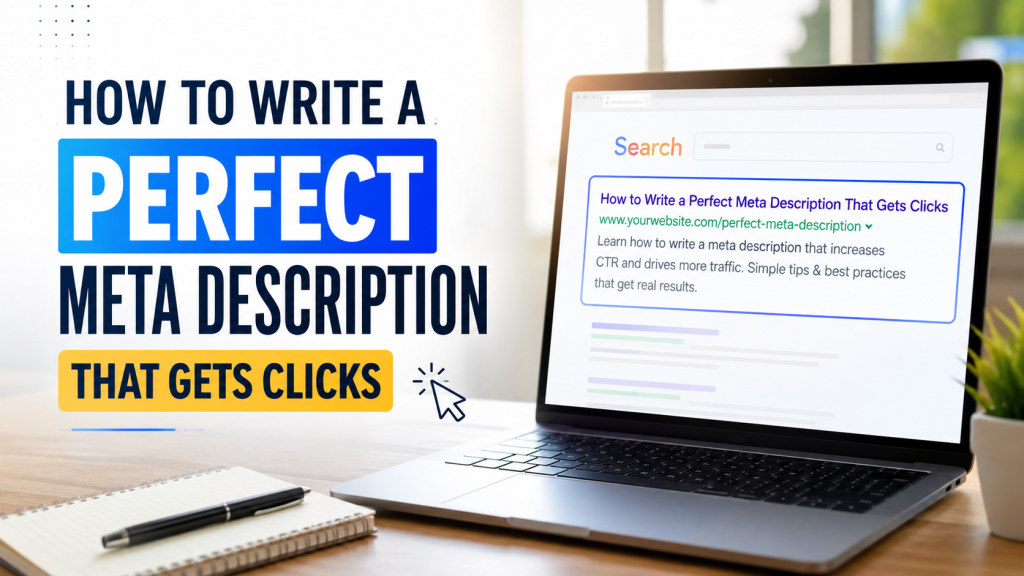
Meta descriptions are one of the most underestimated elements in SEO. They don’t directly influence how Google ranks your page, but they absolutely determine whether someone clicks on it. A well-written meta description is essentially a six-second sales pitch sitting between you and your next reader. Get it right and your organic click-through rate improves. Get it wrong and even a top-three ranking can underperform.
This guide covers everything you need to know: what makes a meta description work, how to write one that earns clicks, how they fit into the emerging world of AI-generated search results, and how to produce them at scale without sacrificing quality.
Key Takeaways:
- Meta descriptions don’t affect rankings directly, but they significantly influence organic CTR, which compounds over time.
- The ideal length is 140-160 characters; anything longer gets truncated by Google.
- Google rewrites meta descriptions roughly 60-70% of the time when yours doesn’t match the searcher’s intent (according to Portent’s 2022 analysis).
- AI search tools like Perplexity and Google’s AI Overviews use page metadata as a summary signal, making well-written meta descriptions a GEO asset.
- AI-assisted workflows let content teams produce accurate, on-brand meta descriptions at scale without quality falling off.
What a Meta Description Actually Does (and Why Most Get It Wrong)
A meta description is the short snippet of text that appears beneath a page’s title in search engine results. It lives in your page’s HTML as a <meta name="description"> tag and typically displays around 155 characters on desktop before Google cuts it off.
Here’s what surprises many marketers: meta descriptions are not a direct ranking factor. Google confirmed this years ago. Your page will not rank higher because you stuffed your target keyword into the description three times. What meta descriptions do is influence human behavior. They are the deciding factor for a large share of searchers who have already seen your title and are deciding whether to click or scroll past.
The reason most meta descriptions fail is one of three things. Either the page has no meta description at all (so Google auto-generates one, usually pulling a random sentence from the body), or the description is technically correct but completely generic (“Learn more about our services”), or it was written with keyword density in mind rather than the reader’s actual intent. None of those approaches work well.
The Anatomy of a Click-Worthy Meta Description
Strong meta descriptions share a recognizable structure. They are not a random sentence pulled from the introduction; they are deliberately constructed to convert a searcher into a visitor.
The core components are:
- Primary keyword placement near the start (Google bolds matching terms in SERPs, which draws the eye)
- An action verb that creates momentum (“Discover,” “Learn,” “See how,” “Find out”)
- A clear value proposition that answers the implicit question: why this page, not the other nine?
- A character count that stays within 140-160 characters to avoid truncation
The fastest way to understand this is through contrast. Compare these two meta descriptions for the same article:
Weak: “Meta descriptions are important for SEO. This article explains what they are and how to write them for better results.”
Strong: “Learn how to write meta descriptions that earn clicks, not just impressions. Practical examples, length guidelines, and AI search tips included.”
The second version is specific, action-oriented, and signals what the reader will actually get. It doesn’t try to rank; it tries to persuade.
One more thing worth knowing: Google rewrites meta descriptions roughly 60-70% of the time, according to a 2022 analysis by Portent. The primary reason is intent mismatch. If your meta description doesn’t reflect what the page actually delivers for a given query, Google will override it with content it thinks is more relevant. Writing a strong description reduces how often that happens.
Meta Description Best Practices: The Rules That Actually Matter
Most best-practice guides give you a list of rules. The problem is that some rules matter more than others. Here are the ones that genuinely move the needle.
Match search intent exactly. Your meta description should reflect the dominant intent behind the queries you’re targeting. An informational query (“how to write a meta description”) calls for a description that promises to teach something. A commercial query (“best meta description generator”) calls for a description that emphasizes outcomes and credibility. Getting this wrong is the single most common reason Google rewrites your description.
Use active voice. Passive constructions make descriptions feel vague and bureaucratic. “Meta descriptions are explained in this guide” is weaker than “This guide shows you how to write meta descriptions that earn more clicks.” One is a statement; the other is an invitation.
Write unique descriptions for every page. Duplicate meta descriptions are a widespread problem on large sites. They confuse both users and search engines, and they waste an opportunity to differentiate each page. If you’re managing hundreds of URLs, this is where AI-assisted workflows become essential, which we’ll cover shortly.
Stay within 140-160 characters for desktop, shorter for mobile. Mobile SERPs truncate earlier, sometimes around 120 characters. If mobile traffic matters to your audience, aim for the lower end.
How Meta Descriptions Affect AI-Generated Search Results
This is the angle most SEO guides miss entirely, and it’s becoming increasingly important.
GEO note: Generative Engine Optimization (GEO) refers to the practice of structuring content so that AI systems, including Google’s AI Overviews, ChatGPT Browse, and Perplexity, are more likely to cite, summarize, or surface your page in AI-generated answers. Meta descriptions play a quiet but real role in this process.
When an AI system crawls a page to decide whether it’s worth citing, it reads metadata alongside body content. A well-written meta description functions as a compact summary signal: it tells the AI what the page is about, what claim it makes, and how authoritative it sounds. Pages with vague or missing meta descriptions give AI systems less to work with.
Most SEO practitioners agree that as AI Overviews and retrieval-augmented generation (RAG) become the default interface for many searches, the “summary quality” of a page becomes a stronger ranking input. Your meta description is the most visible and editable summary element you control.
This connects directly to E-E-A-T principles (Experience, Expertise, Authoritativeness, Trustworthiness). A concise, specific, accurate meta description reinforces the signal that the page knows what it’s talking about. A generic one undermines it.
If you’re optimizing content for both search engines and AI engines, tools built around GEO principles, like the SEO/GEO writing tool at ContentSuper, treat meta optimization as part of the same workflow, not a separate afterthought.
Writing Meta Descriptions at Scale Without Losing Quality
For a single landing page, writing a great meta description takes about five minutes. For a site with 500 URLs, it becomes a project. This is where most content teams either give up and let Google auto-generate everything or produce descriptions so formulaic they might as well be auto-generated.
The solution isn’t to lower the standard; it’s to systematize the process.
AI-assisted content workflows can draft meta descriptions directly from a page’s content brief or existing body copy. The key is giving the AI the right inputs: the primary keyword, the page’s dominant search intent, the target character count, and the value proposition the page delivers. With those inputs, a well-prompted AI model produces descriptions that are accurate, on-brand, and click-oriented.
Quality control still matters. Before publishing at scale, check for: intent alignment (does the description reflect what the page actually delivers?), keyword presence (is the primary term near the start?), length compliance (under 160 characters?), and uniqueness (no two pages share the same description).
Google Search Central’s guidance on snippets is worth bookmarking here. It explains exactly how Google generates snippets when no meta description is present, which tells you a lot about what Google is trying to do and how you can do it better yourself.
ContentSuper’s AI visibility tool integrates meta description generation into the article production process, so teams aren’t going back to add metadata manually after the fact.
Testing and Measuring Meta Description Performance
Writing better meta descriptions is only half the work. Measuring whether they’re actually performing is what separates teams that improve from teams that guess.
Google Search Console is your primary tool. Navigate to the Performance report, filter by page, and track organic CTR over time. When you rewrite a meta description, note the date and monitor CTR for the following 4-6 weeks. A meaningful improvement is typically a 10-30% relative CTR gain, though this varies heavily by industry and query type.
What counts as a “good” organic CTR? According to Sistrix’s large-scale SERP analysis, average CTR for position one is around 28%, but this drops to roughly 15% for position two and under 10% by position five. If your page sits in positions 2-5 and is pulling CTR well below those benchmarks, the meta description is usually the first thing worth testing.
True A/B testing of meta descriptions isn’t natively supported in Google Search Console, but you can approximate it by making one change at a time and treating the before/after comparison as a controlled test. Some teams use Google Optimize or similar tools for this when statistical rigor matters.
The metric to watch alongside CTR is impressions vs. clicks ratio over time. If impressions are stable or growing but clicks are flat or declining, your description isn’t converting interest into action.
Frequently Asked Questions
Does a meta description affect SEO rankings?
No, meta descriptions are not a direct Google ranking factor. Google has confirmed this repeatedly. What they do affect is organic click-through rate, which is a behavioral signal that can indirectly influence how Google evaluates a page’s relevance over time. A page with strong CTR relative to its position tends to maintain or improve its ranking; a page with weak CTR may slip. So while the description doesn’t move rankings directly, it creates conditions that do.
How long should a meta description be in 2025?
The practical target is 140-160 characters for desktop search results. Google typically displays around 155 characters before truncating with an ellipsis. For mobile, aim closer to 120 characters since mobile SERPs have less display space. Character count matters more than word count here; count characters, not words, when reviewing your descriptions.
What happens when Google rewrites my meta description?
Google rewrites meta descriptions when it determines that your version doesn’t closely match what a searcher was looking for. It pulls replacement text from your page body, often from the section most relevant to the query. You can reduce rewrites by writing descriptions that precisely reflect the page’s content and dominant search intent. Even when Google does rewrite, a well-structured page with clear, intent-matched content gives it better raw material to work from.
Should I use keywords in my meta description?
Yes, but naturally. When a search query matches words in your meta description, Google bolds those words in the SERP snippet, which draws the eye and increases CTR. Place the primary keyword near the beginning of the description where it’s visible before any potential truncation. Avoid repeating keywords or including secondary keywords in ways that make the description read unnaturally; the goal is persuasion, not keyword density.
Can AI write good meta descriptions?
Yes, with the right inputs. AI performs well on meta descriptions when given a clear primary keyword, the page’s search intent, a target character limit, and the core value proposition the page delivers. Without those inputs, AI-generated descriptions tend to be generic. The best workflow treats AI as a first drafter and a human editor as the quality check, particularly for high-traffic pages where CTR improvements have the most impact.
Write Better Meta Descriptions Faster with ContentSuper
A well-crafted meta description is a small piece of content with outsized impact. It doesn’t take long to write one well, but at scale, or across a site that’s never had a consistent approach, the gap between good and mediocre descriptions adds up fast in lost clicks.
ContentSuper’s platform is built to close that gap. The AI visibility tool tracks how your content performs not just in traditional search but across AI-generated answers, so you can see whether your metadata and content signals are working where search is heading. And the SEO/GEO writing tool means meta descriptions don’t get bolted on at the end; they’re part of the content from the start.
If you haven’t audited your meta descriptions recently, that’s the starting point. Pick your ten highest-impression, lowest-CTR pages in Google Search Console and rewrite their descriptions using the principles in this guide. The results are usually visible within a month.