
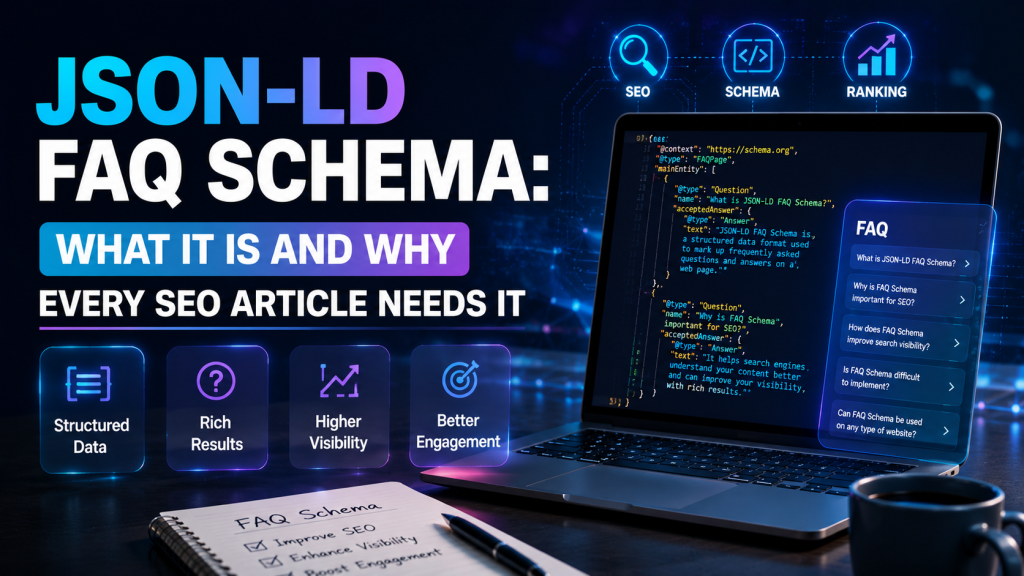
JSON-LD FAQ schema is a piece of structured data that tells search engines and AI systems exactly which text on your page answers which question. It’s written in a machine-readable format called JSON-LD (JavaScript Object Notation for Linked Data), and it wraps your existing FAQ content in a way that makes it instantly parsable. If you publish SEO content and you’re not using it, you’re leaving two things on the table: rich results in Google’s search pages, and citations in AI-generated answers from tools like ChatGPT and Perplexity. This article covers what JSON-LD FAQ schema actually is, how it works, why it matters for both SEO and GEO (Generative Engine Optimization), and how to implement it without hand-coding every article.
Key Takeaways:
- JSON-LD FAQ schema is structured data that explicitly labels question-and-answer pairs so search engines and AI models can extract them cleanly
- It powers expandable FAQ rich results in Google Search, which can increase your SERP visibility without a ranking change
- AI engines rely on structured, self-contained Q&A pairs to generate accurate, citable answers, making FAQ schema a core GEO tactic
- Google tightened FAQ rich result eligibility in 2023, so schema must match visible content and come from real, useful questions
- Tools like ContentSuper can auto-generate valid FAQ schema directly from your article’s FAQ section, removing the manual coding step
What Is JSON-LD FAQ Schema, and Why Should You Care
JSON-LD FAQ schema is a snippet of code, typically placed in the <head> of a webpage, that marks up a set of questions and their corresponding answers using a shared vocabulary called schema.org. When a search engine or an AI crawler reads your page, it doesn’t have to guess which paragraph answers “How long does shipping take?” The schema tells it directly, in a format built for machines rather than for human eyes.
This matters more today than it did five years ago. Search results now blend traditional blue links with AI Overviews, and a growing share of research happens inside AI assistants rather than a search bar. Both contexts reward content that is unambiguous and easy to extract. FAQ schema is one of the simplest, highest-impact ways to make your content structurally readable to machines, on top of being useful to your human readers.
Most SEO practitioners agree that schema markup alone won’t move rankings the way backlinks or content depth will. But it changes how your content gets presented and reused, which is arguably just as important in a search landscape shaped by AI Overviews and zero-click search.
How JSON-LD FAQ Schema Actually Works
At its core, FAQ schema is a JSON object with a type of FAQPage, containing a list of Question items. Each question has a name field (the question text) and an acceptedAnswer field (the answer text, nested under Answer). Here’s the structure conceptually:
FAQPage schema is a schema.org type that packages one or more question-and-answer pairs into a single structured block, allowing search engines to display them as expandable results directly in the SERP and allowing AI systems to extract clean, attributable answers during retrieval.
The code itself doesn’t need to be visible on the page. It sits quietly in the page’s source, usually inside a <script type="application/ld+json"> tag. What does need to match, though, is the content: the questions and answers in your schema should mirror what a visitor actually sees on the page. Search engines have gotten stricter about this, and mismatched schema can get your rich results disqualified entirely.
Why FAQ Schema Matters for Traditional SEO
The most visible payoff of FAQ schema is the rich result: an expandable accordion of questions that appears directly under your listing in Google Search, sometimes pushing your result to occupy significantly more vertical space on the page. More SERP real estate generally means a better shot at organic CTR, even without a ranking improvement.
Google’s own structured data documentation outlines exactly which FAQ formats qualify for rich results and which don’t, and it’s worth reviewing directly since eligibility rules have shifted over time. As of recent updates, FAQ rich results are primarily available to certain verified site types, which makes it even more important to treat FAQ schema as a content quality signal rather than a guaranteed ranking hack.
Beyond rich results, well-structured FAQ content also supports featured snippets and “People Also Ask” boxes, both of which draw directly on the same kind of clear, self-contained question-and-answer formatting that FAQ schema requires.
Why FAQ Schema Matters Even More for GEO
If traditional SEO rewards FAQ schema with a visual upgrade in the SERP, GEO rewards it with something arguably more valuable: a higher chance of being the source an AI model quotes. Tools like ChatGPT, Gemini, and Perplexity don’t crawl a page and read it top to bottom the way a person does. They retrieve chunks of content, often through a process resembling RAG (Retrieval-Augmented Generation), and they favor chunks that are self-contained and unambiguous.
A well-structured FAQ, especially one reinforced with schema, is exactly that kind of chunk. Each question-and-answer pair stands alone. It doesn’t require surrounding paragraphs for context, which is precisely the property that makes it easy for a language model to lift and cite accurately. The emerging consensus in GEO circles is that structured, direct-answer content consistently outperforms narrative prose when it comes to AI citation rate.
This is part of why AI visibility tool tracking has become a meaningful metric for content teams. If your FAQ sections are structurally sound and your competitors’ aren’t, you have a real, measurable edge in how often your brand shows up when someone asks an AI assistant a question in your category. Combined with a deliberate GEO optimize tool approach across your content library, FAQ schema becomes one input in a much larger visibility strategy, not a one-off tactic.
Common Mistakes That Get FAQ Schema Ignored or Penalized
A few recurring mistakes strip FAQ schema of its value, or worse, get it disqualified:
Mismatched content. The schema says one thing, the visible page says another. Search engines check for this, and AI systems that cross-reference multiple sources will treat inconsistent pages as lower-trust.
Promotional, vague answers. Questions like “Why should you choose us?” answered with marketing copy instead of a real answer don’t qualify for rich results and don’t get cited by AI models either, since there’s nothing concrete to extract.
Invalid JSON syntax. A missing comma or bracket can silently break the entire schema block. It’s worth validating markup before publishing rather than assuming it works because it looks right.
Questions nobody actually asks. Schema built around invented questions instead of real search queries or genuine user concerns tends to underperform, both in rich result eligibility and in topical relevance signals.
How to Generate and Implement FAQ Schema Without Manual Coding
Writing JSON-LD by hand for every article is tedious, and it’s easy to introduce a syntax error that quietly breaks the whole block. This is one area where an SEO/GEO writing tool earns its keep: rather than hand-coding schema for each new post, the FAQ section you write during content creation can be converted directly into valid JSON-LD automatically.
The workflow is straightforward. You write your article’s FAQ section as genuine Q&A content, using real questions and direct, useful answers. Once the article is saved, the schema is generated automatically from those same question-and-answer pairs, guaranteeing that your visible content and your structured data always match. You copy the generated block into the page’s <head>, and it’s live. No separate schema-writing step, no risk of the mismatch problem covered above.
This approach also scales. If you’re publishing dozens of SEO articles a month as part of a broader content velocity strategy, manually maintaining schema for each one isn’t realistic. Automating it from the source content removes an entire category of technical SEO debt before it accumulates.
FAQ Schema Best Practices for Maximum Visibility
A few practices consistently separate FAQ schema that performs from FAQ schema that gets ignored:
- Base your questions on real queries: pull from “People Also Ask” boxes, actual customer support tickets, or search console data rather than guessing.
- Lead every answer with a direct response in the first sentence. Save nuance and caveats for the sentences that follow.
- Keep answers concise, in the 60 to 100 word range. Long enough to be genuinely useful, short enough to stay scannable and citable.
- Revisit and update your FAQ schema whenever the underlying content changes. Stale answers that no longer match current pricing, features, or policies erode topical authority over time.
- Avoid duplicating the exact same FAQ block across many pages. Search engines and AI systems both treat unique, page-specific FAQs as stronger signals than templated ones.
Frequently Asked Questions
Does FAQ schema still work in 2026?
Yes, but its function has shifted. FAQ rich results in Google Search are now available to a narrower set of eligible sites than they were a few years ago, so the guaranteed SERP visual boost is less universal. That said, FAQ schema still plays a strong role in GEO, since AI systems continue to favor structured, self-contained Q&A content when generating and citing answers.
Can I add FAQ schema without writing code myself?
Yes. Most modern CMS platforms and dedicated SEO content tools can generate valid JSON-LD automatically from a properly formatted FAQ section. Instead of writing the markup by hand, you write genuine Q&A content, and the schema is produced from that source, reducing both the technical burden and the risk of syntax errors.
Does FAQ schema help with AI Overviews and AI Assistants?
Indirectly, yes. FAQ schema itself doesn’t guarantee inclusion in AI Overviews or chatbot answers, but the underlying practice, structuring content into clear, self-contained question-and-answer pairs, is exactly what makes content easier for AI systems to retrieve and quote accurately. It’s a GEO best practice as much as an SEO one.
How many FAQs should I include per article?
Three to five well-chosen questions typically works best. Enough to cover the genuine follow-up questions a reader would have, without diluting the page with filler questions added purely to pad the schema block. Quality and specificity matter more than quantity here.
Turn Every Article Into an AI-Citable Asset
FAQ schema is a small technical addition with an outsized effect on how your content gets found, whether that’s through a Google rich result or a citation inside an AI-generated answer. The real work isn’t the markup itself, it’s writing FAQ content that’s genuinely useful, direct, and structured well enough to deserve the schema wrapped around it.
If you want that structure built in from the start rather than retrofitted after publishing, ContentSuper’s AI Generate workflow writes FAQ sections as part of every article and produces the corresponding JSON-LD automatically. Read our AI Content guide to see how the full workflow fits together, or dig into our AI Content writing guide for a deeper look at how SEO and GEO principles get baked into every piece of content we help you produce.