
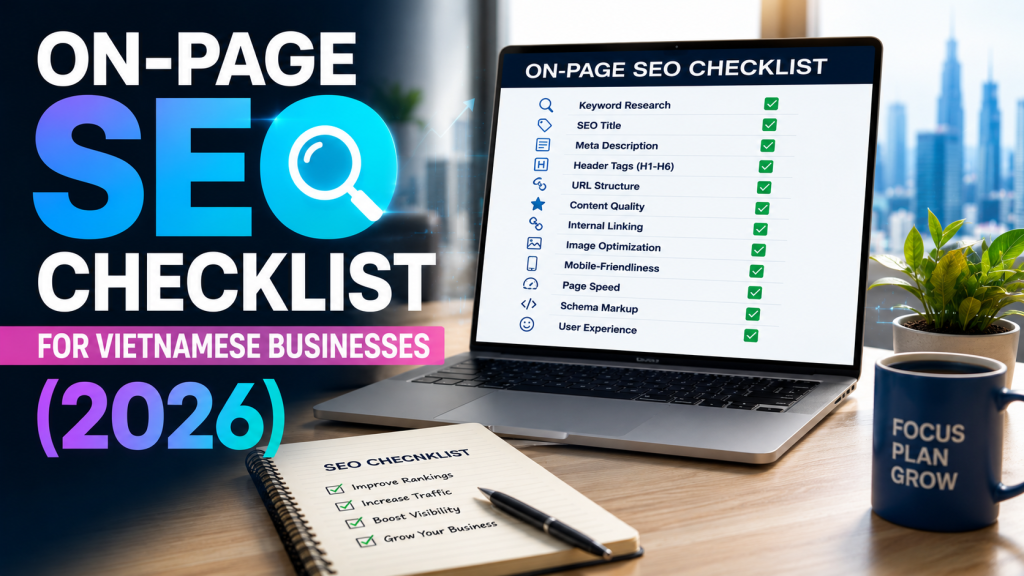
On-page SEO in 2026 looks different than it did even two years ago. Google now blends traditional rankings with AI Overviews, and platforms like ChatGPT and Perplexity have become genuine discovery channels for Vietnamese consumers researching products and services. For Vietnamese businesses, this means the old checklist (keyword in the title, meta description under 160 characters, done) is no longer enough. This guide walks through the on-page elements that matter most right now: title tags, header structure, internal linking, technical setup, and the newer discipline of GEO (Generative Engine Optimization), which determines whether AI tools mention your brand at all. Follow this checklist and you will have a page structure built for both Google’s crawlers and the AI models increasingly standing between you and your customer.
Key Takeaways:
- On-page SEO now needs to satisfy both traditional search rankings and AI-generated answers
- Title tags and meta descriptions for Vietnamese audiences often need to account for mixed Vietnamese and English search behavior
- Internal linking through topic clusters strengthens both crawlability and topical authority
- GEO (Generative Engine Optimization) is a distinct discipline from SEO, focused on AI citation rather than SERP ranking
- Technical basics like JSON-LD schema and page speed remain foundational, not optional
Title Tags and Meta Descriptions That Work for Vietnamese Search Intent
Vietnamese search behavior is rarely monolingual. A user researching “phần mềm quản lý bán hàng” one day might search “best inventory software Vietnam” the next, especially in B2B and SaaS categories. Your title tag needs to reflect the language your actual customers use, not the language you assume they use.
Start with the primary keyword close to the front of the title. Google still weights early keyword placement, and Vietnamese users scanning search results tend to read the first few words before deciding whether to click. If your business serves both Vietnamese speakers and an international audience, consider whether you need separate language versions rather than trying to blend both into a single tag.
Meta descriptions should stay under 155 to 160 characters and include a clear reason to click: a benefit, a number, or a direct answer to the implied question. According to Backlinko’s ranking factors research, pages with compelling meta descriptions see meaningfully higher click-through rates even when rankings stay flat. Avoid generic descriptions like “Learn more about our services” that could apply to any page on the internet.
Header Structure (H1 to H3) and Content Hierarchy
Every page needs exactly one H1 that states the main topic clearly. From there, H2s should break the page into logical sections, and H3s should nest under the relevant H2 for sub-points. This is not just a stylistic preference: both Google’s crawlers and AI models like Gemini use header hierarchy to understand what a page is actually about.
Where a heading poses a question, such as “What is on-page SEO?”, the paragraph directly underneath should answer it in the first sentence. This direct-answer format is one of the clearest signals for AI citation, since AI models tend to lift the first sentence under a heading when constructing their own answers. Most SEO practitioners agree that clean, logical header hierarchy has become more important, not less, as search evolves toward AI-generated summaries.
Internal Linking and Site Architecture for Vietnamese Businesses
Internal links tell both search engines and AI crawlers how your content relates to itself. A page that links naturally to related, relevant content signals topical depth. A page that stands alone, disconnected from the rest of your site, signals the opposite.
The most effective structure for Vietnamese businesses building out content at scale is the pillar and satellite model: one comprehensive pillar page on a broad topic, surrounded by narrower satellite pages that each link back to the pillar and to each other where relevant. This is exactly the structure ContentSuper’s Topic Cluster Planner is built around, letting you plan a pillar topic, generate a list of satellite articles, and track which ones are written versus still gaps.
If you are producing content with an AI writing tool, look for one that can generate SEO- and GEO-optimized content directly, since this saves the extra step of retrofitting AI Visibility considerations into content written for search rankings alone (as ContentSuper offers with its SEO starter guide from Google Search Central as a useful technical reference point).
For anchor text, use descriptive phrases rather than generic “click here” links. A well-chosen anchor gives both readers and crawlers context about the destination page before they even click. ContentSuper’s Internal Links feature automates part of this by matching relevant pages to new articles based on keyword overlap, so link placement stays consistent as your content library grows.
GEO Readiness: Optimizing for AI Answers, Not Just Google
GEO, or Generative Engine Optimization, is the practice of structuring content so it gets cited or referenced when someone asks ChatGPT, Gemini, Perplexity, or Claude a question in your category. It sits alongside traditional SEO rather than replacing it.
GEO (Generative Engine Optimization) is the discipline of optimizing content so that generative AI systems surface, cite, or reference it when answering user questions, distinct from traditional SEO’s focus on search engine rankings.
The emerging consensus in GEO is that AI models favor content with specific, citable claims over vague generalizations. Named tools, defined terms, and attributed statistics all increase the odds that a model treats your page as a reliable source. Structured Q&A content, where each answer stands independently, also performs well because AI systems can extract a single answer without needing the surrounding context.
For Vietnamese businesses, this is a genuine opportunity. Most competitors have not yet built GEO into their content process, which means brands that do it now have a real head start on AI mention rate. You can track this directly with a tool like ContentSuper’s AI Visibility checker, which monitors how often your brand shows up when real user prompts are sent to major AI platforms.
The table below outlines how SEO and GEO differ in practice:
| Dimension | Traditional SEO | GEO |
|---|---|---|
| Goal | Rank in search engine results pages | Get cited in AI-generated answers |
| Primary signal | Backlinks, keywords, page authority | Citable claims, entity density, structured answers |
| Measurement | Rankings, organic traffic | AI mention rate, share of voice in AI answers |
| Content format | Keyword-optimized long-form pages | Direct-answer, Q&A-structured content |
Technical On-Page Elements: Schema, Images, and Page Speed
Technical fundamentals have not gone away just because GEO exists. JSON-LD FAQ schema remains one of the more reliable ways to earn rich results in Google and give AI systems structured, machine-readable answer pairs. If your page includes genuine Q&A content, generating and embedding FAQ schema in the page’s <head> is a low-effort, high-value step.
Image alt text deserves the same bilingual thinking as your title tags. Write alt text in whichever language matches how a real user would search for that image, and keep it descriptive rather than keyword-stuffed. Page speed, meanwhile, remains a foundational ranking factor. Core Web Vitals such as Largest Contentful Paint and Cumulative Layout Shift still influence both user experience and search performance, and a slow page undermines every other optimization on this checklist.
FAQ: On-Page SEO for Vietnamese Businesses
What is the difference between on-page and off-page SEO?
On-page SEO covers everything you control directly on your website: title tags, headers, content quality, internal linking, and technical setup. Off-page SEO covers external signals like backlinks from other sites and brand mentions. Both matter, but on-page SEO is where you have the most direct control and the fastest path to improvement.
How often should on-page elements be updated?
Review title tags, meta descriptions, and content freshness at least every six months, or sooner if rankings drop or a competitor overtakes you. Pages targeting fast-moving topics, such as pricing or product comparisons, benefit from more frequent updates since outdated information hurts both user trust and AI citation reliability.
Does GEO replace traditional SEO?
No. GEO addresses a different discovery channel (AI-generated answers) rather than replacing search engine rankings. Most businesses need both: traditional SEO to capture search traffic and GEO to capture AI-driven mentions and recommendations, which are becoming a meaningful share of how customers first hear about a brand.
Do Vietnamese businesses need separate SEO strategies for Vietnamese and English content?
Often yes, particularly for B2B or SaaS businesses with an international audience. Search intent, keyword volume, and even the AI platforms used differ between Vietnamese-language and English-language searchers. Treating both as a single undifferentiated audience usually means underperforming in both.
Put This Checklist Into Action
Working through this checklist manually across dozens of pages takes real time, and it is easy for on-page elements to drift out of consistency as a content library grows. ContentSuper was built to close that gap: every article generated through the platform is structured for SEO and GEO from the first draft, with header hierarchy, internal linking, and AI-citable formatting baked in rather than added afterward.
If you want a deeper walkthrough of how SEO and GEO work together in practice, ContentSuper’s guide to AI SEO content writing covers the fundamentals in more depth. And if you are ready to see where your brand currently stands in AI-generated answers, running a free check is the fastest way to find out.