
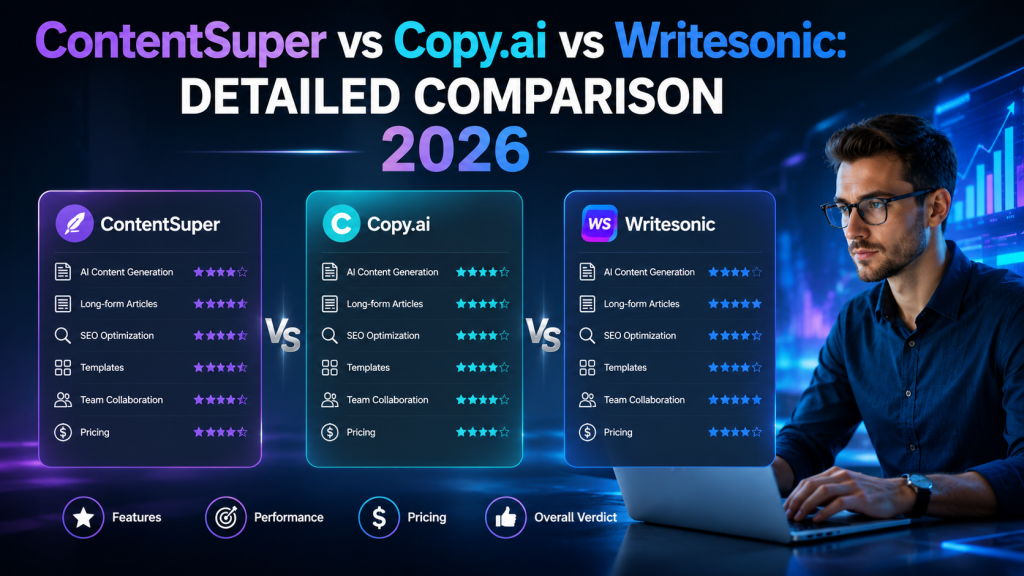
If you’re choosing between ContentSuper, Copy.ai, and Writesonic, the short answer is this: Copy.ai and Writesonic are strong generalist AI writing tools built around templates and marketing copy, while ContentSuper is built specifically for SEO + GEO (Generative Engine Optimization) content production with a built-in AI Visibility Checker that tracks whether your brand actually gets mentioned by ChatGPT, Gemini, Claude, and Perplexity. If your priority is ranking on Google and showing up in AI-generated answers at the same time, that combination matters more than raw template count.
This comparison breaks down what each platform does well, where the workflows diverge, how pricing stacks up, and which tool fits which kind of team.
Key Takeaways:
- Copy.ai and Writesonic are broad AI writing tools with templates for ads, emails, and short-form copy.
- ContentSuper focuses on long-form SEO content paired with GEO optimization built into every article.
- Only ContentSuper includes a native AI Visibility Checker that measures brand mentions across AI platforms.
- ContentSuper’s Topic Cluster Planner and Bulk Generate features are designed for teams publishing at scale, not one-off posts.
- Pricing starts at $12/month for ContentSuper’s Starter plan, with AI Visibility checks included from the first paid tier.
What Copy.ai and Writesonic Actually Do Well
Copy.ai built its reputation on marketing copy: ad variations, email sequences, and workflow automation tools that chain AI outputs together for go-to-market teams. It’s less about long-form SEO articles and more about producing many short pieces of copy quickly, which makes it a reasonable fit for performance marketers who need constant creative variation.
Writesonic leans into bulk article generation and browser-based writing assistance through its Chrome extension. It supports a wide range of content types, from product descriptions to landing pages, and its appeal is breadth: one tool that can plausibly handle almost any writing task a marketing team throws at it.
Both platforms are competent generalist writers. What they don’t do, structurally, is treat SEO and GEO as a single connected workflow, and neither one tells you whether your brand is actually showing up when someone asks an AI assistant a question in your category.
Where ContentSuper Is Built Differently: SEO + GEO in One Workflow
ContentSuper’s SEO/GEO writing tool runs on a deliberate three-step process rather than a single prompt-to-output template. You start by selecting a Brand Profile, which stores your tone of voice, target audience, keywords to use and avoid, and contact details so every article stays on-brand automatically. From there, you generate an editable outline before any full draft gets written, so you can restructure headings before committing generation credits to a direction that doesn’t work.
The platform also supports nine distinct article formats, including SEO Article, Pillar Page Hub, How-to Guide, Listicle, FAQ Article, and Comparison/vs, each with its own structural instructions for how AI should build headings and write content. That’s a meaningfully different approach from a single generic “blog post” template: a comparison article and a how-to guide have different information needs, and ContentSuper’s format system reflects that.
For teams publishing at scale, the Topic Cluster Planner adds pillar-and-satellite content planning, complete with a suggested publish order and a bulk generation queue that writes multiple articles sequentially. Neither Copy.ai nor Writesonic offers an equivalent cluster-planning feature tied directly to article generation.
AI Visibility: The Feature Copy.ai and Writesonic Don’t Have
This is the biggest structural difference between ContentSuper and its generalist competitors. Most SEO practitioners agree that ranking on Google is no longer the only visibility metric that matters: users increasingly ask ChatGPT, Gemini, Claude, and Perplexity directly for product and service recommendations, and if your brand isn’t part of that answer, you lose the click before a search engine result page even enters the picture.
ContentSuper’s AI visibility tool addresses this directly. You create Prompts, the actual questions real users type into AI assistants, and the system checks whether your brand appears in the response across selected AI platforms. Each check is tracked over time with a Visible/Not Visible status, a Change indicator (New, Stable, Up, Down, Lost), and an overall AI Visibility Score that shows the percentage of prompts where your brand shows up.
The Overview tab also surfaces Competitor Visibility, comparing your brand’s presence against named competitors in the same AI-generated answers, along with a Sources panel listing the URLs AI models cite when mentioning your brand. Copy.ai and Writesonic have no comparable feature; they generate content but give you no signal on whether that content, or your brand generally, is being surfaced by AI systems at all.
What is GEO (Generative Engine Optimization)? GEO is the practice of structuring content, entities, and claims so that AI systems like ChatGPT and Perplexity are more likely to cite or reference a brand in generated answers. Where SEO optimizes for search engine crawlers and ranking algorithms, GEO optimizes for how large language models retrieve, summarize, and attribute information, and the two disciplines increasingly need to be handled together rather than in isolation.
Feature-by-Feature Comparison Table
| Feature | ContentSuper | Copy.ai | Writesonic |
|---|---|---|---|
| Long-form SEO article generation | Yes, 9 dedicated formats | Limited, template-based | Yes, bulk-focused |
| GEO optimization built into content | Yes, native to every article | No | No |
| AI Visibility Checker (ChatGPT, Gemini, Claude, Perplexity) | Yes, native feature | No | No |
| Topic Cluster Planner | Yes, pillar + satellite structure | No | No |
| Bulk article generation queue | Yes, sequential with auto-save | Workflow automation (copy-focused) | Yes, bulk-oriented |
| Brand Profile with tone/keyword control | Yes | Partial (brand voice settings) | Partial |
| Internal link automation | Yes, AI-matched by content relevance | No | No |
| Entry price point | $12/month (Starter) | Varies by plan | Varies by plan |
The emerging consensus in GEO-focused content teams is that visibility tracking and content generation need to sit in the same platform, since fixing a visibility gap almost always means revising the content that created it in the first place. That loop is harder to close when your writing tool and your visibility data live in two separate products.
Pricing Breakdown: ContentSuper vs Copy.ai vs Writesonic
ContentSuper’s pricing is structured around four tiers. The Free Trial runs 7 days with no credit card required, giving you 1 brand profile, 3 articles total, and 1 topic cluster to test SEO and GEO scoring. The Starter plan is $12/month and includes 1 brand profile, 10 articles per month, 3 topic clusters per month, and 10 AI Visibility checks per month, which is notable because AI Visibility access starts at the entry-level paid tier rather than being locked behind a higher plan.
Pro, at $26/month, scales to 3 brand profiles, 30 articles per month, 10 topic clusters per month, 25 AI Visibility checks per month, and custom instructions for finer control over AI output. Business, at $49/month, is built for agencies and larger content teams: 10 brand profiles, 75 articles per month, 25 topic clusters per month, 60 AI Visibility checks per month, custom instructions, and data export.
Copy.ai and Writesonic pricing varies by plan and word-count tier, and neither includes an equivalent to AI Visibility checks in any plan, since neither platform tracks AI-generated answer visibility at all. If you’re comparing cost per article alone, that’s a fair lens. If you’re comparing cost per unit of “content that ranks and gets cited,” the AI Visibility allowance changes the math, since you’re paying for a feedback loop the other two tools simply don’t offer.
Which Tool Fits Your Workflow?
If your team’s main need is short-form marketing copy at high volume, ads, emails, social captions, Copy.ai’s template library and workflow automation are a reasonable fit. If your priority is broad content coverage across many content types with minimal structure, Writesonic’s bulk approach and browser extension offer convenience.
But if your content strategy depends on SEO rankings and AI-generated answer visibility working together, particularly for a content team running topic clusters, tracking multiple brand profiles, or trying to close the loop between “we published this” and “AI systems actually mention us,” ContentSuper’s combination of the AI Content guide workflow and native AI Visibility tracking is purpose-built for that use case in a way neither generalist tool currently matches.
FAQ
Is ContentSuper better than Copy.ai for SEO content?
For long-form SEO content specifically, ContentSuper is more purpose-built: it offers 9 dedicated article formats, an outline-approval step before full drafts, and GEO optimization baked into every piece. Copy.ai is stronger for short-form marketing copy and templated workflows, so the better choice depends on whether your primary output is articles or campaign copy.
Does Writesonic track AI visibility?
No. Writesonic focuses on content generation, including bulk article creation and browser-based writing assistance, but it does not include a feature that checks whether your brand appears in AI-generated answers from ChatGPT, Gemini, Claude, or Perplexity. That kind of tracking currently exists as a native feature in ContentSuper’s AI Visibility Checker.
What is GEO and why does it matter in 2026?
GEO, or Generative Engine Optimization, refers to structuring content and brand information so AI models are more likely to cite or recommend a brand in generated answers. It matters increasingly because users are asking AI assistants directly for recommendations rather than relying solely on search engine results pages, and content that isn’t optimized for AI retrieval risks losing that visibility entirely.
Can I switch between AI writing and AI visibility tracking in one tool?
Yes, within ContentSuper. Both capabilities live in the same platform under one Brand Profile, so you can generate an AI SEO content writing piece, publish it, then track whether it or your brand generally starts appearing in AI-generated answers, without switching tools or re-establishing brand context somewhere else.
Try ContentSuper’s AI Visibility Checker
If you’re already investing in SEO content and want to know whether that effort is translating into AI visibility, it’s worth testing directly rather than guessing. ContentSuper’s GEO optimize tool and AI Visibility Checker run in the same workspace as your content generation, so you can see the connection between what you publish and whether AI systems actually mention your brand. Start with the free 7-day trial to generate a few articles and run your first visibility checks before deciding on a plan.